First Thoughts on Alfred Bester

A writer I interviewed two weeks ago for my Billy Batson project told me a long, sad story about science fiction writer Alfred Bester. A couple of days later I visited William Fiedler at the Gallery Bookstore, one of the last science fiction/pulp bookstores here in Chicago. The Gallery is easy to find. Just take the Red or the Brown line to Belmont and, once you’re off the train, walk to the Lake. You’ll see it, on your right.

Fiedler had two copies of Bester’s 1953 novel The Demolished Man, which won the Hugo. I bought the cheaper of the two, a $35 copy of the 2nd printing–without the dust jacket (I would have paid closer to $500 for the one with the jacket). First serialized by H.L. Gold in Galaxy Science Fiction in 1952 and published by Chicago-based Shasta a year later, the novel is a futuristic murder mystery about a high-powered, vengeful gambler and the telepathic cop who’s out to get him. The story begins with the following paragraph, Bester’s space-age revision, I think, of the Book of Ecclesiastes:

In the endless universe there is nothing new, nothing different. What may appear exceptional to the minute mind of man may be inevitable to the infinite Eye of God. This strange second in life, that unusual event, those remarkable coincidences of environment, opportunity, encounter…all may be reproduced over and over on the planet of a sun whose galaxy revolves once in two hundred million years and has revolved nine times already.

My writing students–and sometimes my colleagues–will ask, “Is this original? How do I express my own thoughts? How will I know?” But this passage, like its ancient Biblical equivalent, seems to suggest that, all long, we’ve been asking the wrong questions. But, then again, “all may be reproduced”–may be, but not with any certainty.

Also, much later in the book, as Lincoln Powell, the psychic cop, pursues Ben Reich, the gambler, across an asteroid made to resemble a jungle resort, Bester writes, “The hippos hit the barrier first in a blind, blundering rush.” A “herd of hippos,” that is, as we learn just one paragraph earlier, along with “swambats and the crocodiles” and, later, “the wapiti, the zebra, the gnu…heavy, pounding herds.”

Lincoln Powell, it turns out, can also talk with space animals when he’s tracking a villain.

So, although you don’t need me to tell you so, read The Demolished Man, and then go back to the Gallery and read Charles Saunders, Henry Kuttner, C.L. Moore, Fritz Leiber. Ecclesiastes, space hippos, telepaths, elephants. It’s all there, including several pages of what looks like concrete poetry. I haven’t enjoyed a novel this much in years.

Comics and Poetry: Tony Trigilio’s “Soldier, 1942” and Harvey Pekar and R. Crumb’s “Miracle Rabbis”

Scan 6

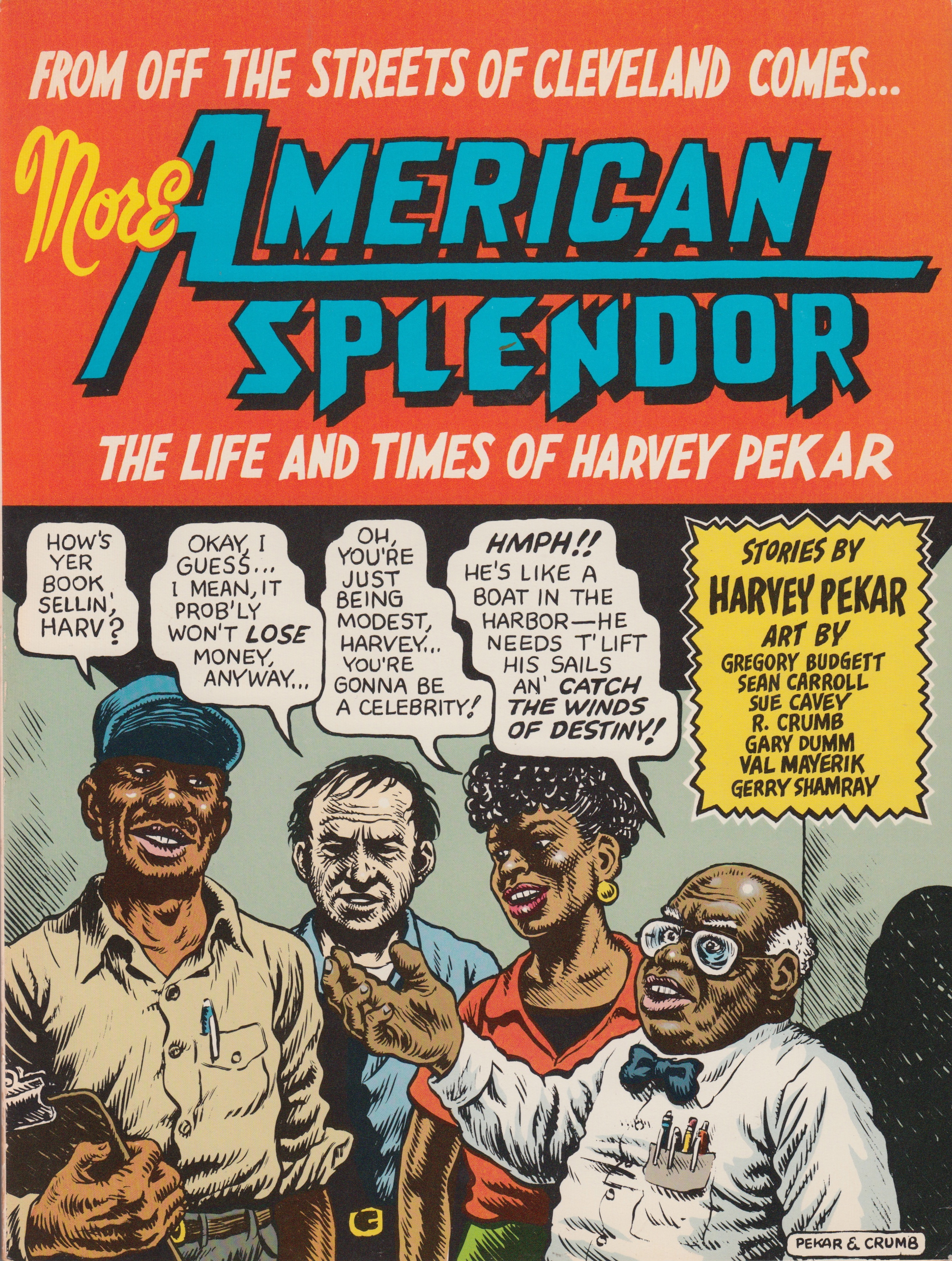
The R. Crumb cover for Harvey Pekar’s More American Splendor (Doubleday & Company, Inc. 1987)

At the close of her essay “Secret Labor,” published in Poetry magazine last summer, Hillary Chute provides several examples of the intersections between comics and poetry. She includes, for example, Art Spiegelman’s illustrated version of Joseph Moncure March’s The Wild Party, Eric Drooker’s work with Allen Ginsberg, and Monica Youn’s Ignatz. Regarding Youn’s book of poems, Chute writes, “I, for one, want to see more of that: poetry about comics.” In the months since Chute published her essay, we’ve seen responses from Noah Berlatsky at The Atlantic and, more indirectly, from Michael Chaney at Dartmouth, whose next Illustration, Comics, and Animation Conference will address, in part, these connections between poetic practice and the world of comics and comic art. One of the Calls for Papers for the 2014 Dartmouth Conference asks, “Can Comics Be Poetry?”

For Chicago poet Tony Trigilio, whose new collection, The Complete Dark Shadows (of My Childhood), Book 1, has just been published by BlazeVOX Books, comics and poetry are narrative forms that call attention to space and to absence. In a 2004 interview, The Spoon River Poetry Review asked Trigilio about the strong narrative pulse of his work. Noting the “very story-oriented, narrative, representational, and almost, at times, fictive” nature of his poetry, the Spoon River editor asked, “How is it that you’ve come to write this way? What influences led you here?” Early in his response, Trigilio describes an inspiration that might have come as a surprise to the journal’s readers:

My narrative influences don’t come exclusively from poetry. I’m thinking of the way stories are constructed visually and verbally, and with gaps in “sense” we expect from poetry, in Harvey Pekar’s comics, which I’ve been lovingly obsessed with since the late 1980s.

As I read this interview, I began to think of these “gaps in ‘sense’” and how they might shape a reading of one of Trigilio’s poems, “Soldier, 1942,” from his 2006 collection The Lama’s English Lessons, and Pekar’s “Miracle Rabbis, a Doctor Gesundheit Story,” drawn by Robert Crumb and included in the 1987 collection More American Splendor. Just as “Soldier, 1942” might be read as a comic—that is, as a series of words and pictures—“Miracle Rabbis” might be read as a poem. In reading the two together, I’d like to extend the potentially rich dialogue between comics and poetry Chute began in her essay. But in order to talk about the Trigilio’s poem and Pekar’s comic, I’ll have to begin with a brief digression about history and photography. “Soldier, 1942,” after all, is partly an ekphrastic poem, as the speaker describes a World War II photograph of his father.

The link between comics and photography, of course, is a complex subject, one Marianne Hirsch began exploring in her discussion of Art Spiegelman’s Maus in her influential 1997 study Family Frames. More recently, Michael A. Johnson at Pencil, Panel, Page asked the question, “Why do artists use photographs in drawn comics?” Hirsch offers a few possible answers to this question when, as she studies Spiegelman’s inclusion of photographs of his mother, father, and brother in Maus, she writes, “In moving us from documentary photographs—perhaps the most referential representational medium—to cartoon drawings of mice and cats, Spiegelman lays bare the levels of mediation that underlie all visual representational forms” (Hirsch 25).

While Spiegelman includes photographs in his text—as Hirsch points out, most notably and startlingly the image of his mother in the “Prisoner on the Hell Planet”—Trigilio’s speaker describes a photograph of his father. The photograph, itself, however, functions like a panel from a comic book, complete with commentary written like a text box on the back of the image. In a “boot camp headshot” the speaker’s father sent home at the start of the war, the young solder has written a note to his mother and father:

Back of the photo, he writes:

“Hey, ma & dad, this is supposed to be me.”

Me, too, black-and-white patina, splinters,

I study his image as it crumbles

in my hands, like damp wood flaking from

the backyard tool shed we tore down

when I was 12.

This photograph, like a poem, is filled with those “gaps in ‘sense,’” even for the subject himself: “Hey, ma & dad, this is supposed to be me.” A few lines later, the speaker offers a possible reading of the photograph, but, as outsiders, we cannot share in this moment of illumination. “I can almost see the roiled anatomy of Yalta,” the speaker begins,

foretold in the sediment of this photograph,

in my father’s eyes flush-brown

with maps and legends like he’s asking the camera

what he’ll see when he’s shipped away.

But I’ll return again to the note on the back of the photograph: “…this is supposed to be me.” The young soldier doesn’t recognize himself, not quite. Should we, as readers, or like his son, complete that thought? …this is supposed to be me. But that’s not me. That’s someone else.

And what does the son see in this photograph? A few lines earlier, he describes his father’s “humble bluster, ready to take down Japan, / our ontology: this is supposed to be me.” Spiegelman tells us the same story in Maus: this is supposed to be me. This is supposed to be my father. This is supposed to be my mother. This is what I know. This is what I’ve been told. This is what I think I remember. That’s a kind of comic book—not just words and pictures, but a series of possibilities, each one a little farther away from its point of origin. At some time and place in 1942, the snapshot tells us, the speaker’s father sat down for a photograph. Then, fifty or sixty years later, the poet transformed that image into a series of words—a translation, or those “levels of mediation” Hirsch describes in her chapter on Maus.

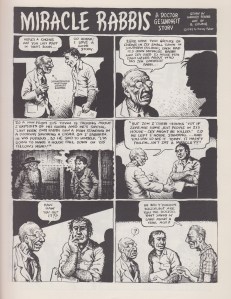
And “Miracle Rabbis”? Another series of mistakes, of stolen or missing identities. First, Doctor Gesundheit tells Harvey a joke. In the fifth panel of the first page, the doctor, having finished his story in the fourth panel, asks, “Haw haw you get it??” He looks eagerly at Harvey, who stands with a file in one hand. There is a shadow on the wall behind him. Like the doctor, we wait for Harvey’s reply, but, in the next panel, a patient interrupts the two men: “Ah beg y’pordon doctor, but are you the doctor that saved m’ lahf about a year ago?”
Scan 3

The first page of “Miracle Rabbis” by Harvey Pekar and R. Crumb from More American Splendor

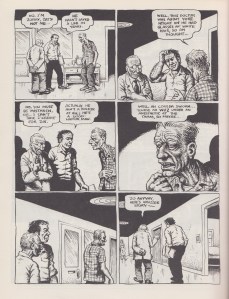
On the next page, Doctor Gesundheit denies that he saved the man’s life. As he does so, Crumb adds a series of details to the image. While, on the first page, we inhabit the same abstract space as the Doctor and Harvey, we are now standing with the three men in the hallway of a hospital. In the first panel of the second page, we see a door, a window, another doorway, a table, a cup, a stack of towels:
Scan 4

The second and final page of “Miracle Rabbis”

The patient has reminded us and the Doctor and Harvey of our bodies, of our movement in space. But the patient, for all his effort, can’t find the doctor he’s looking for, unless Gesundheit and Harvey are joking with him. The fifth panel on this second page echoes the fifth panel on the first page: there is a pause; once again, we wait for a punch line. As the Doctor and Harvey stare at him, the patient walks away, and Crumb includes sketches of the ceiling, other doorways, windows, mail slots, door handles. And, in the final panel of the story, as a nurse enters the frame, Doctor Gesundheit tells another joke: “Zo, anyvay, here’s anuzzer story—” The two men walk the hallway together, and, as readers, we look ahead to the story on the next page.

The patient in Pekar’s story might have asked his differently: I know you. I think. This is supposed to be you. But those “gaps” are at work here, too, just as they are when we look at any photograph, or read any poem, or study the words and pictures on a comic book page.

A few days ago I asked Tony to remember his favorite comic books from childhood. What comics in the 1970s played a role in shaping his consciousness as a writer and as a poet?

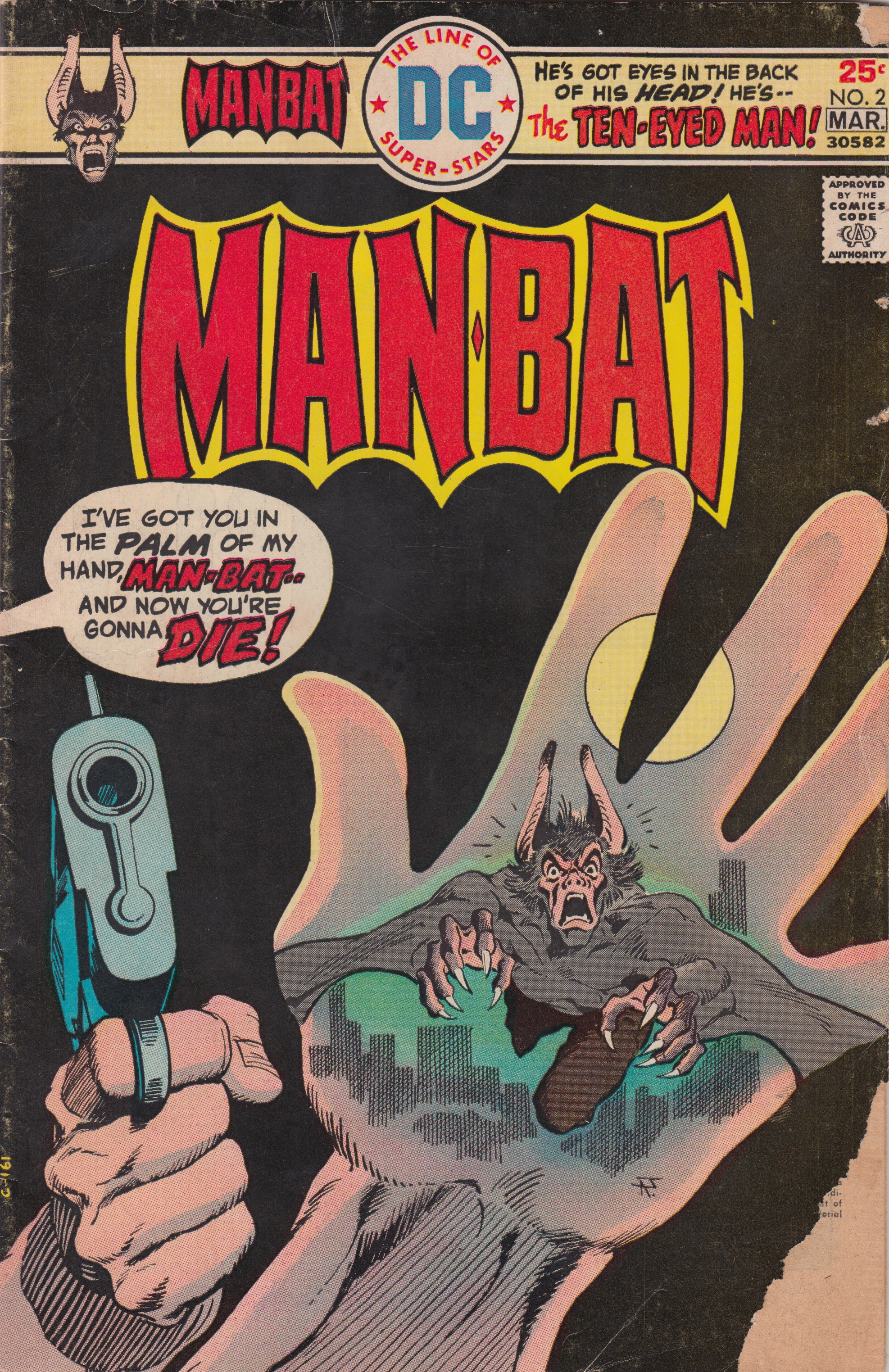
His answer was simple and direct: Man-Bat. Specifically, the little-known, short-lived Man-Bat series DC Comics published in 1975 and early 1976.

Not Batman. Man-Bat.

Scan 5

The Jim Aparo cover for DC Comics’ Man-Bat No. 2 Feb.-Mar. 1976

Tony and I will talk a little more about the poetics of Man-Bat in my next post.

Meanwhile, happy new year!
“Simplicity in Art”

My dad loves the following essay. It comes from his first-year college writing textbook, Writing Prose, edited by Thomas S. Kane and Leonard J. Peters, both of whom were English professors at the University of Connecticut’s Waterbury campus. The essay itself is an excerpt from Frank Norris’s The Responsibilities of the Novelist.

These turn-of-the-century American literary manifestos make for interesting reading. I’m partial to Hamlin Garland’s Crumbling Idols and William Dean Howells’ Criticism and Fiction. My dad spoke so often about this essay that I thought it would be required reading when I got to college. It wasn’t, but maybe it should have been. I’ll always think of it as the story of the spoon, but in their textbook Kane and Peters call it “Simplicity in Art.” As I transcribed it, I realized I’d forgotten about the example Norris provides in its conclusion, and then decided it would make a perfect blog post for the holidays.

Scan 2

“Simplicity in Art”

by Frank Norris

From Thomas S. Kane and Leonard J. Peters (Eds), Writing Prose: Techniques and Purposes (Second Edition), 1964 (p. 36; excerpted from Norris’s The Responsibilities of the Novelist, 1903).

Once upon a time I had occasion to buy so uninteresting a thing as a silver soup-ladle. The salesman at the silversmith’s was obliging and for my inspection brought forth quite an array of ladles. But my purse was flaccid, anemic, and I must pick and choose with all the discrimination in the world. I wanted to make a brave showing with my gift–to get a great deal for my money. I went through a world of soup-ladles–ladles with gilded bowls, with embossed handles, with chased arabesques, but there were none to my taste. “Or perhaps,” said the salesman, “you would care to look at something like this,” and he brought out a ladle that was as plain and as unadorned as the unclouded sky–and about as beautiful. Of all the others this was the most to my liking. But the price! ah, that anemic purse; and I must put it from me! It was nearly double the cost of any of the rest. And when I asked why, the salesman said:

“You see, in this highly ornamental ware the flaws of the material don’t show, and you can cover up a blow-hole or the like by wreaths and beading. But this plain ware has got to be the very best. Every defect is apparent.”

And there, if you please, is a conclusive comment upon the whole business–a final basis of comparison of all things whether commercial or artistic; the bare dignity of the unadorned that may stand before the world all unashamed, panoplied rather than clothed in consciousness of perfection. We of this latter day, we painters and poets and writers–artists–must labour with all the wits of us, all the strength of us, and with all that we have of ingenuity and perseverance to attain simplicity. But it has not always been so–At the very earliest, men–forgotten, ordinary men–were born with an easy, unblurred vision that to-day we would hail as marvelous genius. Suppose, for instance, the New Testament was all unwritten and one of us were called upon to tell the world that Christ was born, to tell of how we had seen Him, that this was the Messiah. How the adjectives would marshall upon the page, how the exclamatory phrases would cry out, how we would elaborate and elaborate, and how our rhetoric would flare and brazen till–so we should imagine–the ear would ring and the very eye would be dazzled; and even then we would believe that our words were so few and feeble. It is beyond words, we should vociferate. So it would be. That is very true–words of ours. Can you not see how we should dramatize it? We would make a point of the transcendent stillness of the hour, of the deep blue of the Judean midnight, of the liplapping of Galilee, the murmur of Jordan, the peacefulness of sleeping Jerusalem. Then the stars, the descent of the angel, the shepherds–all the accessories. And our narrative would be as commensurate with the subject as the flippant smartness of a “bright” reporter in the Sistine chapel. We should be striving to cover up our innate incompetence, our impotence to do justice to the mighty theme by elaborateness of design and arabesque intricacy of rhetoric.

But on the other hand–listen:

“Then the days were accomplished that she should be delivered, and she brought forth her first born son and wrapped him in swaddling clothes and laid him in a manger, because there was no room for them in the inn.”

Comics Reporter Holiday Interview #04

I’d like to thank Tom Spurgeon for including me in this year’s Holiday Interview series at The Comics Reporter. I’ve been reading Tom’s work for years, but I finally got a chance to meet him last month at the Festival of Cartoon Art at Ohio State. He served as moderator for the Walt Kelly panel where Kerry Soper, Steve Thompson, and I got to celebrate the 100th anniversary of the cartoonist’s birth in 1913. The panel, like the Festival, was a lot of fun.

Here is a link: Comics Reporter Holiday Interview #04

I’m thrilled and honored to be part of this year’s interviews, and I’m looking forward to the rest of the series. Also be sure to read the ones Tom posted earlier this week!

And since I talk so much about Mr. Tawny in this interview, I think I’ll include this panel from Otto Binder and C.C. Beck’s “Captain Marvel and Mr. Tawny’s Personality Peril!” from Captain Marvel Adventures #115 (December, 1950; also reprinted in Shazam! Limited Collectors’ Edition #1, Summer 1973).

Fig. 21 Mr. Tawny

Final Thoughts from Columbus

Scan

Discarded items–can these surface men do naught else, save pollute?”

–Namor’s opening reflections from The Savage Sub-Mariner #72 (September 1974), by Steve Skeates (w), Dan Adkins (p), Vince Colletta (i), Artie Simek (l), L. Lessman (c), and Roy Thomas (ed.)

If Grass Green is an Afrofuturist, is Walt Kelly a pioneer of American comic art and ecocriticism? For the last two weeks I’ve been thinking of a question Rebecca Wanzo, Associate Professor of Women, Gender, and Sexuality Studies at Washington University, asked me about Walt Kelly’s final book, We Have Met the Enemy and He Is Us. What might a genealogy of ecocriticism and American comics books and comic strips look like, she asked? What artists and writers should we include? Does environmental awareness in comics begin with Kelly—whose late work, Finis Dunaway reminds us, had an enormous impact on the first Earth Day in 1970—or can we locate earlier examples in the North American comics tradition? And what about examples of ecocriticism in other comic art traditions from around the world?

There are so many possibilities for research, not only in Kelly’s work, but also, for example, in John Porcellino’s comics, especially Thoreau at Walden (and in any number of strips over the years in King-Cat), in Simon Moreton’s recent (and excellent) Grand Gestures, and in Alan Moore’s run on Swamp Thing (see Qiana Whitted’s essay in Comics and the U.S. South). After our Walt Kelly panel, Nancy Goldstein pointed out parallels between Kelly’s images of factories and smokestacks in the later Pogo strips and Jackie Ormes’s work from the early 1950s. I’ve been trying to think of other examples of an ecological awareness in comics, especially ones from the early 1970s, such as the final issue of Marvel’s The Savage Sub-Mariner from 1974 (#72), which opens with this image:

Scan 4

While not as elegant as Walt Kelly’s depictions of the Okefenokee Swamp, Dan Adkins’ splash page, featuring inks by Vince Colletta, is atmospheric and evocative. The rope divides the image in half, with Namor, our hero, in the upper right corner, smaller and less distinct than the tire and the black tennis show that fill the rest of the page. The text boxes and the title—“From the Void It Came…”—at the bottom of the page add to the clutter.

For all its atmosphere, this is a difficult page to read, with all sorts of details competing for our attention. Skeates even includes a clever line about the comic book convention of the thought bubble. In the lower, right-hand corner of the page, we read,

He swims…and the thoughts that trail him—past battles forming present memories—these thoughts enlarge like balloons formed from the bubbles created by his own churning movements[,] thoughts that then transform into slow-burning rage.

In rest of the comic, there is a sometimes awkward relationship between word and image—Skeates’ elaborate prose juxtaposed with Adkins’ large, sparsely detailed panels, often in grids of three.

Over the course of 31 pages, most of them filled with advertisements, Namor battles two surface-dwellers, one of whom attacks because, he explains, “we don’t need any crummy fish-men hanging out around here!” There’s a green space creature who blinds the Sub-Mariner and then miraculously restores our hero’s sight a few pages before the end of the story. Finally, there’s an almost happy ending, as the more tolerant of the two dock-workers rescues his friend and exclaims, “Let’s go back to my pad and have a few drinks. I just bought a new professional wrestling magazine!” Is this another narrative, one embedded in the text—two young men cruising, one tolerant, the other filled with hatred of himself and of anyone else who represents difference?

Scan 5

Anyway, the panels on page 27 are rather tender and surprising. While Namor’s redemption on page 31 is predictable, the first of two panels on page 32—filled with the blue-skinned corpses of Namor’s fellow Atlanteans—returns us to the splash page’s dread and clutter. Look to the right of these final, apocalyptic images and there is an advertisement for fishing poles, lures, and tackle including “50 natural bait lures” and “sure shot action with shrimp, minnows, grasshoppers, mayflies, bumblebees, crickets, leeches”: 

Scan 6

I’m certain the production staffers who placed this ad at the end of the comic did so without intention or irony. A Marvel comic book published in 1974 is filled with advertisements, usually for products and services targeted at boys and young men. But how do we read this ad for bait and tackle in light of the comic’s focus on pollution, intolerance, and final redemption? How does one shape our reading of the other? In his notes for the Arcades Project, Walter Benjamin describes the consumer products that might illuminate a history of the 19th century: “These items on display are a rebus: how one ought to read here the birdseed in the fixative pan, the flower seeds beside the binoculars, the broken screw atop the musical score, and the revolver above the goldfish bowl—is right on the tip of one’s tongue” (see The Arcades Project 540).

I imagine any discussion of comics and the American environmentalist movement would require an analysis of the relationship between, for example, Walt Kelly’s We Have Met the Enemy and He Is Us and Marvin Gaye’s “Mercy Mercy Me (The Ecology)” from his 1971 song cycle What’s Going On. How might this final issue of The Savage Sub-Mariner from 1974 be read in relation to Jimi Hendrix’s “1983…(A Merman I Should Turn To Be)” from his 1968 double-record Electric Ladyland? That miniature Afrofuturist rock opera imagines a world so devastated by nuclear war that the protagonist, like Melville’s Ishmael or the space hippies of Crosby, Stills, and Nash’s “Wooden Ships,” looks to the ocean for escape and survival.

What “1983,” “Wooden Ships,” “Mercy Mercy Me” and even the Sub-Mariner share in common is the sense that our only possible salvation from the environmental catastrophes of the present involves the prophetic use of the imagination. Like the time-travelers of Chris Marker’s 1962 film La Jetée, in which, the narrator tells us, a nuclear holocaust has made space travel impossible, our only hope lies in our ability to move not in space but in time through an act of memory: “Space was off-limits. The only hope for survival lay in Time. A loophole in Time, and then maybe it would be possible to reach food, medicine, sources of energy” (read the fill English translation of the script here).

In Jimi Hendrix and Marvin Gaye, we encounter an Afrofuturism that engages with the present by calling into question our stewardship of the environment. What is the connection between Marvin Gaye’s radical transformation of what was possible for Motown and for soul music and the Sub-Mariner’s struggle with the “surface men” who, he says, do naught else, save pollute”? This Sub-Mariner story is clearly another product of the “relevance” fad that swept comics in the early 1970s. But would it be possible to trace the origins of this socially-conscious form of popular storytelling to the American psychedelic rock, r&b, and funk of the late 1960s?

There’s a story here waiting to be written. Here are a few other places to begin: in Dianne D. Glave’s 2010 book Rooted in the Earth: Reclaiming the African American Environmental Heritage; in Finis Dunaway’s already-mentioned article on the first Earth Day in 1970; in Richard Todd Stafford’s recent Popular Culture Association paper on ecocriticism and Joe Sacco’s comics. I also wonder if Heidi MacDonald’s call earlier this week for a closer analysis of the idea of place in the work of artists including Julia Gförer and Lilli Carré might be understood as an invitation for an ecocritical reading of these contemporary comics. MacDonald points out, for example that

There is a large body of comics work, mostly by males, that deals with the sea and exploration (Nick Bertozzi, Kevin Cannon, Drew Weing, Cristolphe Blain) WHO WORE IT BEST?

Would an ecocritical reading of Anders Nilsen’s Rage of Poseidon be possible? If so, what shape would it take?

I’ll end with a few more notes from Benjamin:

Method of this project: literary montage. I needn’t say anything. Merely show. I shall purloin no valuables, appropriate no ingenious formulations. But the rags, the refuse—these I will not inventory but allow, in the only way possible, to come into their own: by making use of them. (See Benjamin, The Arcades Project 460)

Thanks again to Jared Gardner, Lucy Shelton Caswell, and all the other great folks at OSU for the opportunity to be part of the Academic Conference at this year’s Festival of Cartoon Art at the Billy Ireland Cartoon Library and Museum. It was a wonderful opportunity to see old friends and to meet new ones. For a more detailed final analysis of the Festival, see Tom Spurgeon’s detailed notes and photos at The Comics Reporter.

Grass Green’s Afrofuturism: Notes from Columbus, Part 2

Scan

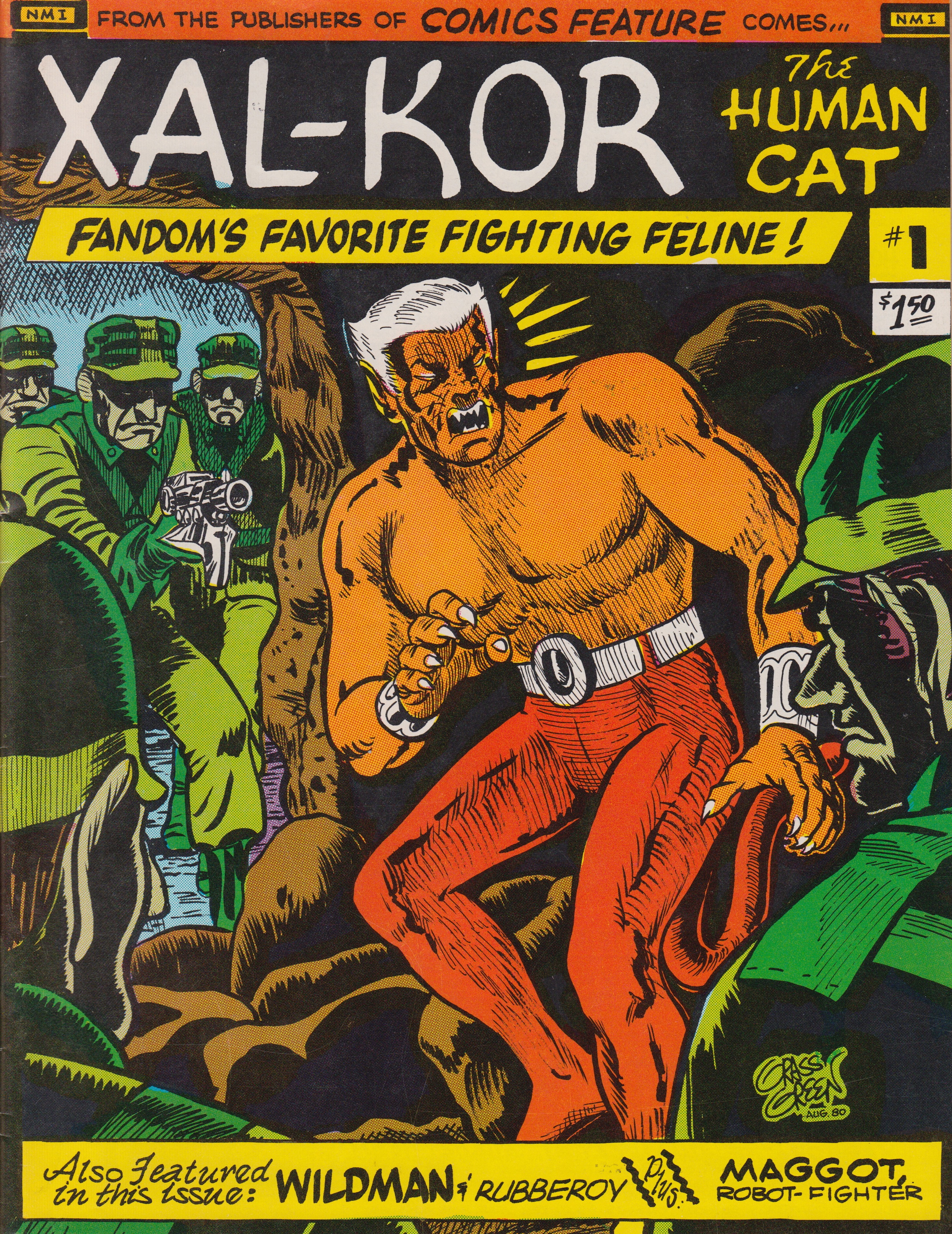
A copy of Richard “Grass” Green’s Xal-Kor, The Human Cat #1, New Media Publishing, August 1980

In a letter dated January 1962, Jack Kirby offered advice and encouragement to aspiring comic book artist Richard “Grass” Green. In the letter, published in the June 2002 issue of Roy Thomas’s Alter Ego magazine, Kirby explains some of the more technical aspects of drawing comic books. “In regard to comic magazine pages,” Kirby writes, “I rule mine to a size of 12 ½ X 18 ½ and divide them into thirds. The size of the individual panels should depend on the artist’s dramatic sense.” Before closing the paragraph, Kirby adds, “Actually, you will find that scenes with the most movement will demand larger space.”

Tom Spurgeon points out Green’s “particular fondness for Jack Kirby and the superhero genre” in an obituary published in The Comics Journal #247 (October 2002) shortly after Green’s death from lung cancer at age 63. Encouraged by Kirby’s letter, Spurgeon writes, “Green became one of the most prolific fanzine artists of his time, contributing pin-up art, adventure stories and parodies to the parade of publications upon which mainstream superhero companies built their fervent, dedicated modern audiences.” I thought again about Green and his work after John Jennings’ talk last week at the Festival of Cartoon Art. John’s talk, “Black Kirby: In Search of the Motherboxx Connection,” included selections from his striking collaborations with Stacey Robinson. Jennings and Robinson sample images from Jack Kirby’s comics in a series of paintings that imagine, for example, what Galactus might look like if he and the Silver Surfer teamed up with Sun Ra’s Arkestra. You can see a few slides from John’s talk on Gene Kannenberg’s Flickr page.

Towards the close of his lecture, John suggested a link between Kirby’s idea of the Source and George Clinton’s vision of the Funk. The Black Kirby images, John explained, are remixes of Kirby’s art and concepts. I began to wonder if Grass Green’s comics, especially the Xal-Kor stories, might be read as significant, early examples of Afrofuturism.

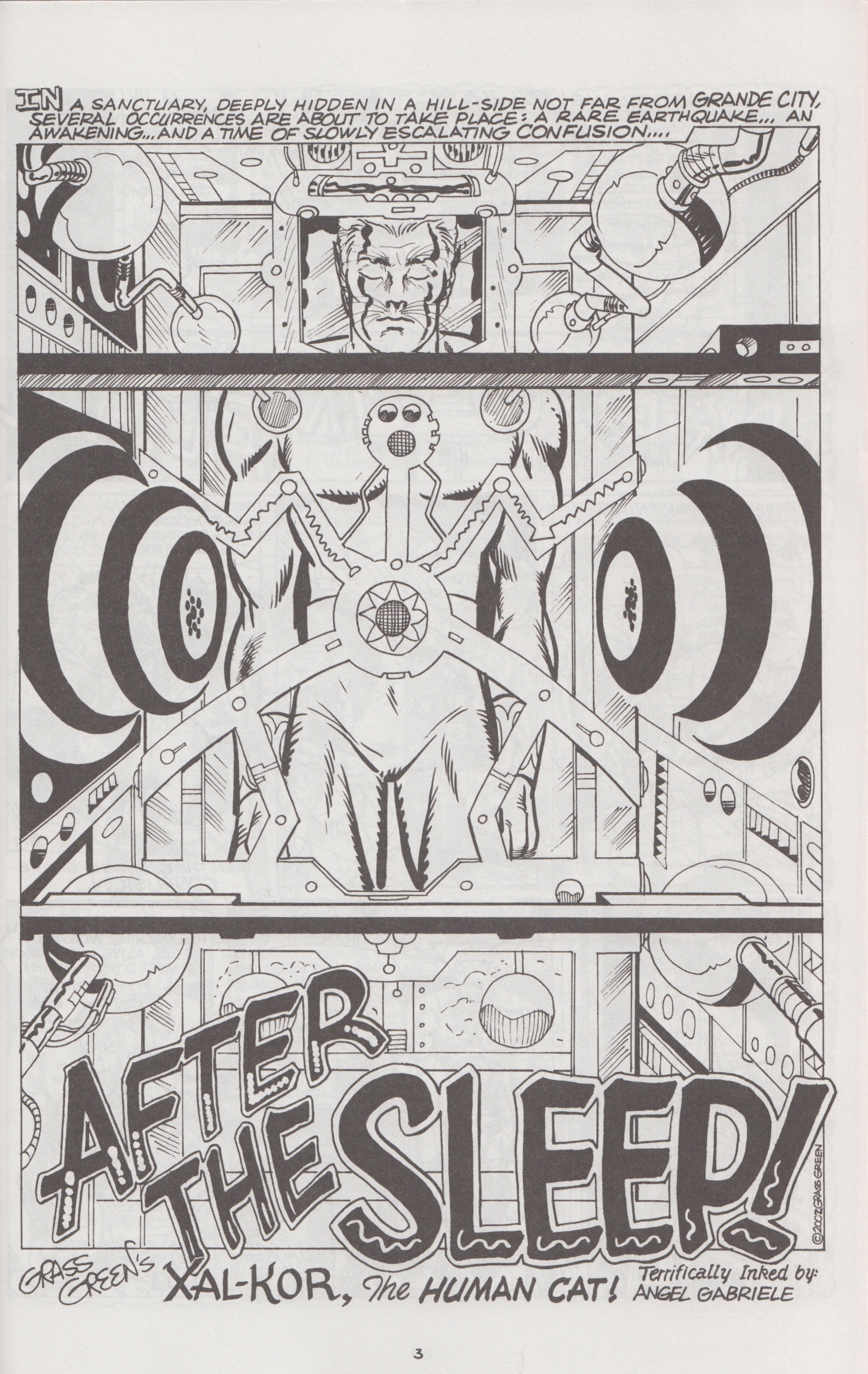
In order to tell the interdimensional tale of Xal-Kor’s fight to contain the evil of Queen Roda and the other citizens of the planet Rodens, Green created a cosmic landscape of bizarre creatures, dynamic action, and slapstick humor. After producing work for Kitchen Sink, Charlton Comics, Renegade Press, and Eros Comics, Green returned to Xal-Kor in a collection published by TwoMorrows in May 2002. The splash page from the TwoMorrows collection, featuring inks by Angel Gabriele, is an image of Xal-Kor in a state of suspended animation:

Scan 7

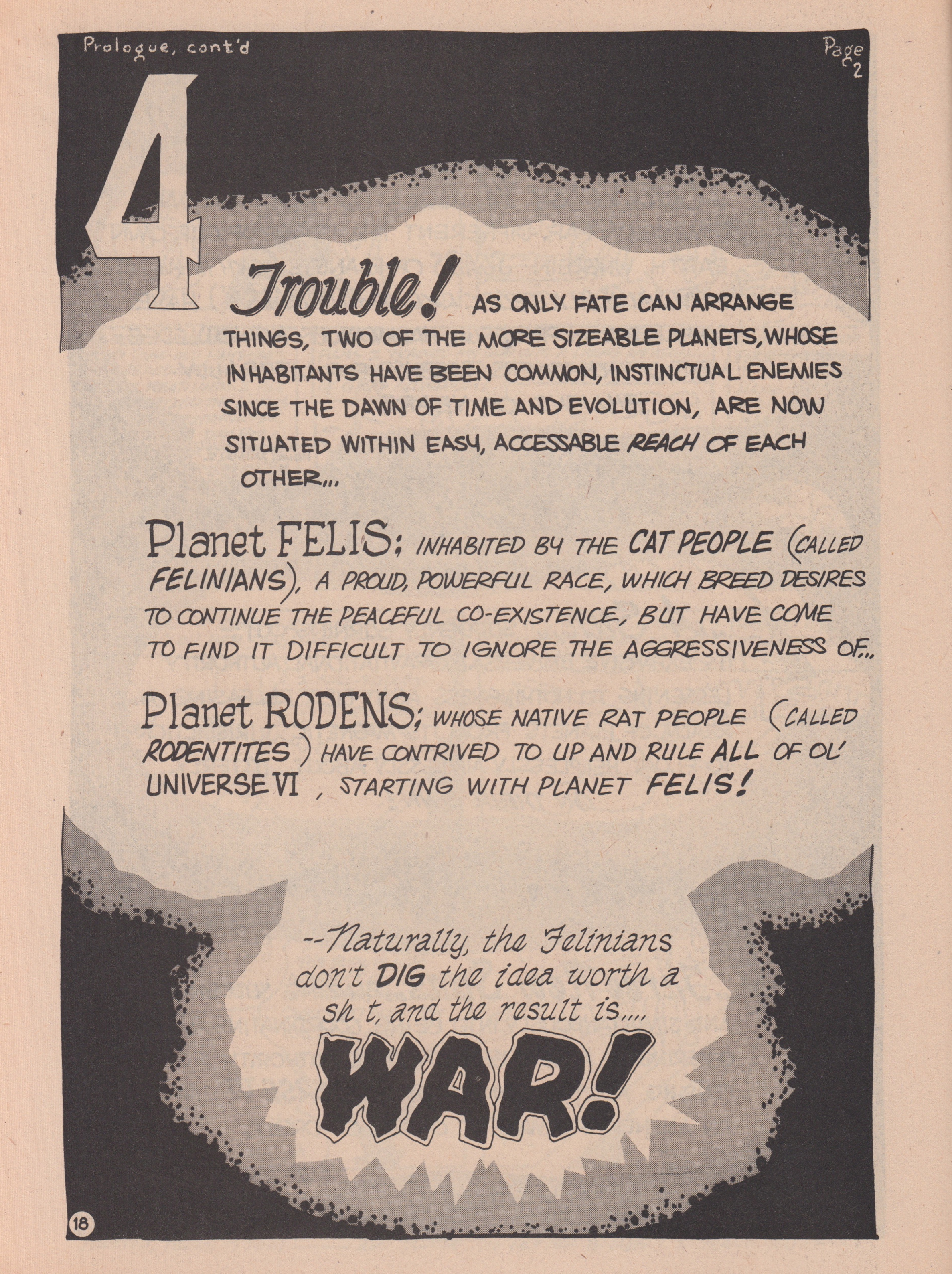
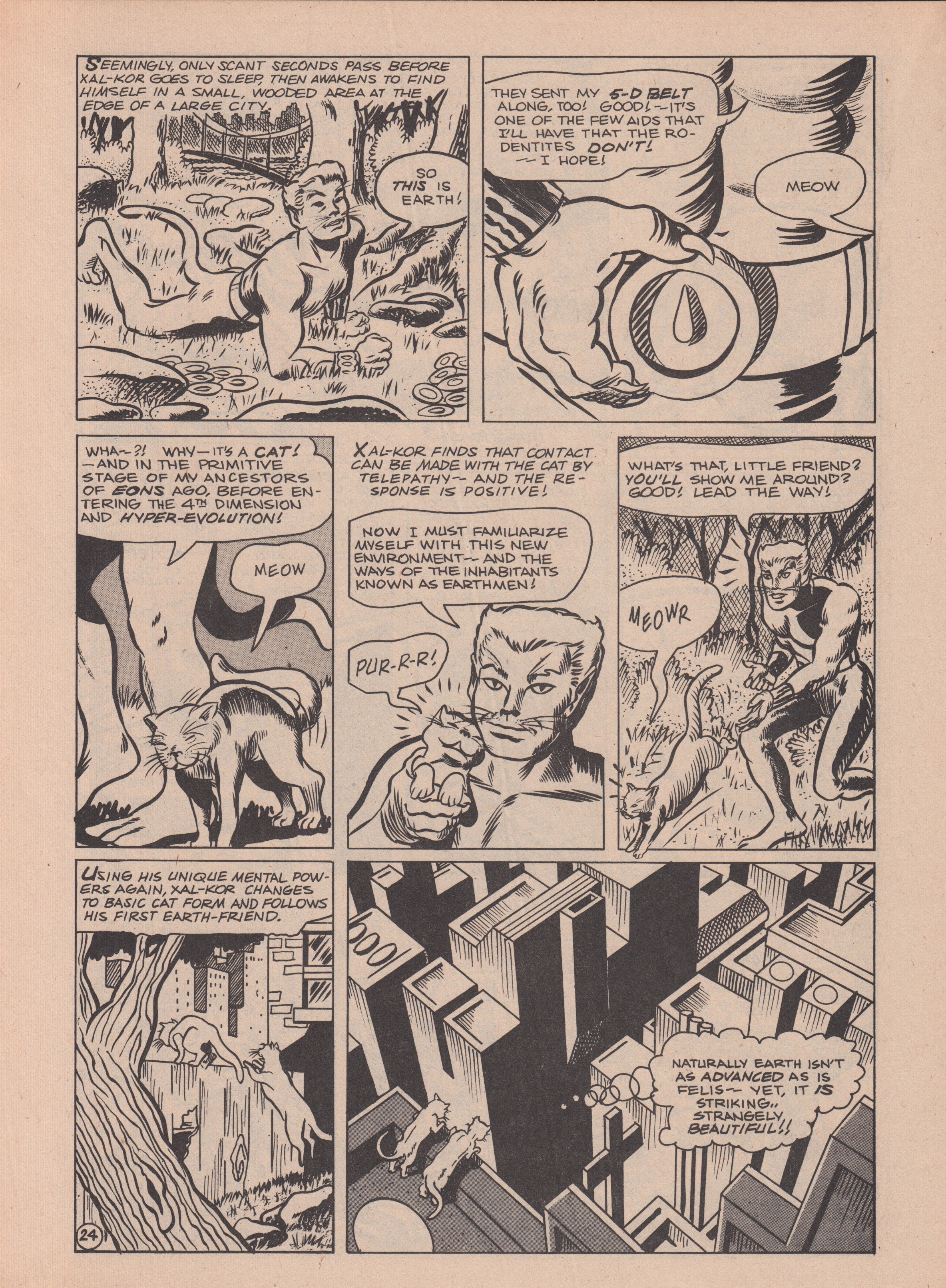
In Green’s 1980 version of Xal-Kor, a character that first appeared in the fanzine Star-Studded Comics in the 1960s, we learn of the ongoing battle between Xal-Kor’s people, the Felinians, and the Rodentites, who have travelled across time and space to reach earth. The “native rat people,” the narrator tells us on a page outlined in traces of Kirby krackle, plan to “rule all of ol’ Universe VI, starting with planet Felis!” The narrator then adds, “—Naturally, the Felinians don’t DIG the idea worth a sh t, and the result is WAR!”

Scan 1

In “Black to the Future: Interviews with Samuel R. Delany, Greg Tate, and Tricia Rose,” Mark Dery describes the Afrofuturism of African American writers, artists, and musicians ranging from George S. Schuyler to Sun Ra, Jimi Hendrix to Octavia Butler, Charles Saunders to Jean-Michel Basquiat. “The notion of Afrofuturism,” he writes, “gives rise to a troubling antimony: Can a community whose past has been deliberately rubbed out, and whose energies have subsequently been consumed by the search for legible traces of history, imagine possible futures?” For Grass Green, the answer to this question involves the “movement” and the “larger space” Kirby described in the January 1962 letter.

The 1980 Xal-Kor, The Human Cat includes several apocalyptic fight scenes in which Planet Felis’s champion defends his people and the earth from the Rodentites. Green’s pencils, featuring inks by Howard Keltner, are strange, exciting, often funny, always engaging. At his best, Green draws with a flair that suggests a Midwestern Raymond Pettibon in love with Jack Kirby, cats, and Chicago (although, in Xal-Kor’s world, the war between the Felinians and the Rodentites takes place in Grande City). When Xal-Kor arrives on earth, he employs “his unique mental powers” to transform himself into “basic cat form” before a domestic shorthair—a creature still “in the primitive stage of my ancestors of eons ago, before entering the 4th dimension and hyper-evolution!”—leads him to a breathtaking cityscape. These earth cats might be primitive, but, in Grass Green’s universe, they climb skyscrapers:

Scan 2

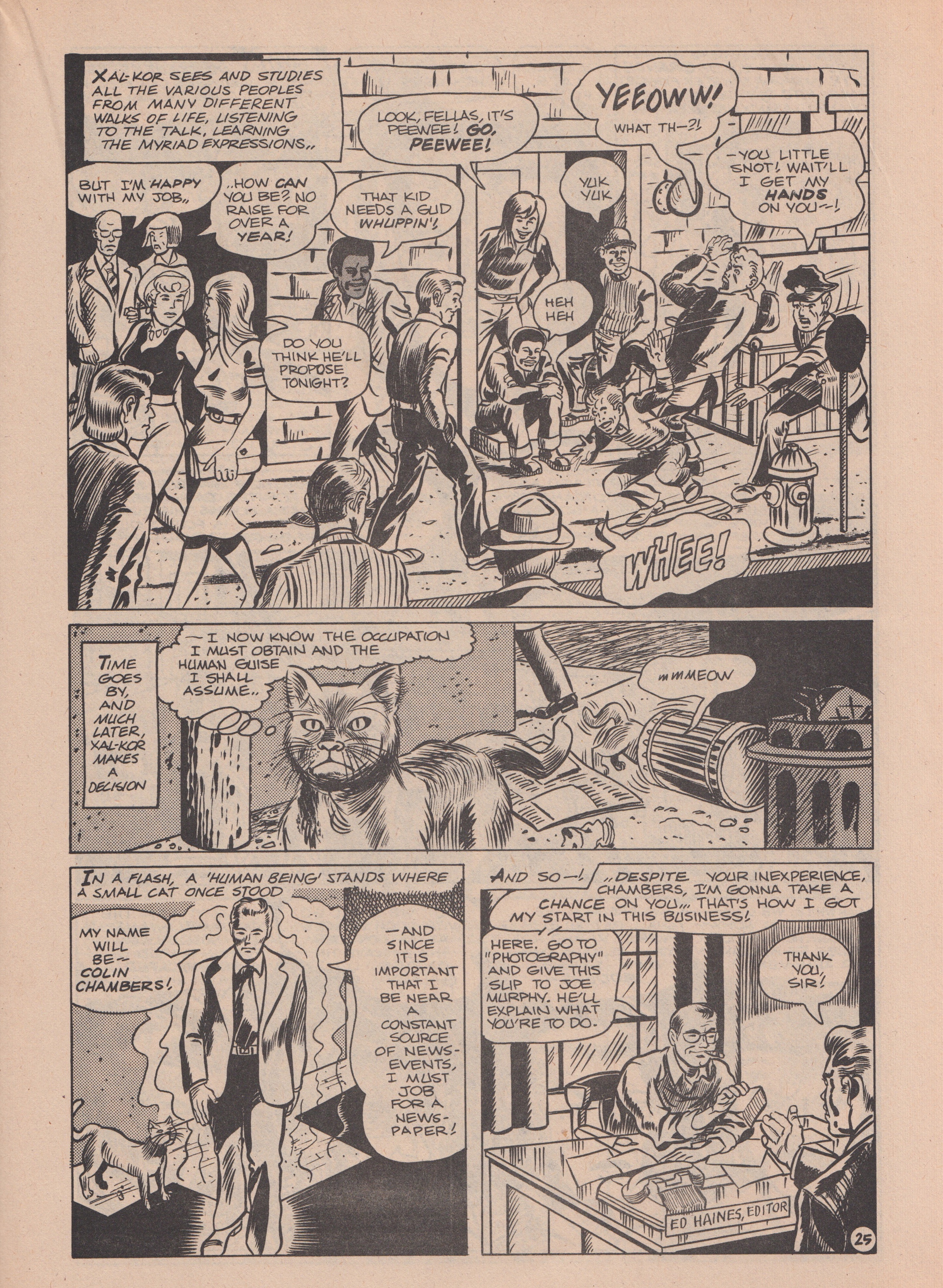
In the first panel of the next page, Green and Keltner include a detailed street scene, one with traces of the urban landscape featured in the artist’s controversial Super Soul Comix #1, published by Kitchen Sink in October 1972. In The Comics Journal’s 2002 obituary, Denis Kitchen suggests that Green “never seemed interested in race relations or politics as subject matter, to my frustration.” Later in his discussion with Tom Spurgeon, Kitchen remarks, “I sometimes wondered whether his raunchy humor disguised experiences too painful to relate or whether he felt his own experiences weren’t interesting enough to tell. But he made it clear he had no interest whatever in creating serious comics.” In Super Soul Comix #1, however, Green takes aim at American racism and hypocrisy as he revisits (remixes?) the tropes of Joe Simon and Jack Kirby’s Captain America. And even Xal-Kor—for all its fanciful, comic (cosmic?) touches—includes evidence of Green’s desire to challenge stereotypes of race, class, and gender common in most superhero comics.

Scan 3

In the text box of the panel’s upper-left corner, the narrator tells us, “Xal-Kor sees and studies all the various peoples from many different walks of life, listening to the talk, learning the myriad expressions…” A balding, middle-aged executive insists that he is happy with his job; a cop chases a boy on a skateboard; three young men marvel at the kid’s speed and daring; two women discuss their relationships as the man behind them, his head turned, remarks, “That kid needs a gud whuppin’!”

In a panel cluttered with word balloons, Green includes the voices of characters from a number of racial and economic backgrounds. In panels like this one, Grass Green is more the Walt Whitman of the underground comics page than the George Clinton of the fan press. He imagines a city like the one Samuel R. Delany describes in his book Times Square Red, Times Square Blue. Green’s street scene is a space in which what Delany calls “interclass contact” is possible:

Contact and its human rewards are fundamental to cosmopolitan culture, to its art and to its literature, to its politics and its economics; to its quality of life. Relationships are always relationships of exchange–semiotic exchange at the base, in a field where, as Foucault explained, knowledge, power, and desire all function together and in opposition within the field of discourse. (See Delany 198-199)

Green is at his most futuristic when his panels are at their most quotidian: men and woman, old and young, black and white, each one walking, talking, and interacting within a visionary, almost utopian urban landscape–the “movement” that “will demand larger space.”

If Afrofuturism as a style or set of strategies is a means of imagining the future, it often begins with attention to the present, even as it struggles to recover the past. Think, for example, of the heroine of Octavia Butler’s Kindred, or the explorers of Pauline Hopkins’ 1903 novel Of One Blood: Or, the Hidden Self. As Paul Gilroy reminds readers in his classic essay on the Black Atlantic, a sense of location–coordinates in time and space–are essential in any attempt to articulate a diasporic identity: “It ain’t where you’re from,” Gilroy reminds us in the title of his essay, “it’s where you’re at,” a line adapted from Eric B. and Rakim’s classic 1987 track “I Know You Got Soul.” In Grass Green’s world, “where you’re at” is always about what you hear; the word balloons that fill his panels are like notes or chord diagrams on a sheet of music. As Tom Spurgeon reminds us in TCJ #247, after all, Green was also a working musician.

A week after John’s lecture, I am still imagining Captain America on board the Mothership, and I am remembering Grass Green’s shape-shifting cats, his time-traveling rat warriors, and his “strangely beautiful” skyscrapers.

1003063164-i00034

Photo of Grass Green (1939-2002) from Tom Spurgeon’s obituary, The Comics Journal #247 (October 2002), p. 32

For more about Grass Green’s impact on comic fan culture and the underground comix scene, see Leonard Rifas’s “Racial Imagery, Racism, Individualism, and Underground Comix” at ImageText. Also read Green’s wife Janice remember her husband here at http://www.inter-fan.org. For more on Kirby’s note to Green, see Bill Schelly’s detailed introduction to the letter on pages 25 and 26 of Alter Ego #15.

Next: A few last words on my OSU trip with notes on Walt Kelly, Namor the Sub-Mariner, and an attempt at a genealogy of comics and ecocriticism.

“The Art of the Future”: Notes from Columbus, Part 1

Scan 6

I spent three days last week at the Festival of Cartoon Art hosted by the Billy Ireland Cartoon Library and Museum at the Ohio State University in Columbus. You can read more about the Festival and the grand opening of the Billy Ireland’s beautiful new building at Charles Hatfield’s blog and in Christian Hoffer’s article at The Outhouse. Tom Spurgeon also includes several links to photos from the Columbus festivities at The Comics Reporter.

I’ll write in more detail about my experiences at the Festival in my next couple of blog posts. As Charles notes in his report, the weekend was so filled with excellent presentations and inspiring talks with artists, scholars, and critics that it’s difficult to know where to begin. Rather than talk directly about the sessions, or about Jeff Smith and Paul Pope, or about the Hernandez Brothers, I’d like to consider a brief conversation I had with Charles about memory and nostalgia and geography.

How does a sense of place shape our understanding of both space and time? Looking out the window of my room on the fifteenth floor of the Hyatt Regency, I saw a network of grey concrete overpasses, redbrick factory buildings, a Wonder Bread sign in huge red letters. I was in Columbus to talk about Walt Kelly and his boyhood in Bridgeport, Connecticut—his family’s move from Philadelphia to the coast of Long Island Sound when he was only two years old; his father’s work at the Remington Arms Company during the city’s World War I boom years; Kelly’s love of bird watching. In the closing paragraphs of my essay I argued that Kelly is a New England regionalist, an artist in the tradition of other writers like Sarah Orne Jewett and Jack Kerouac (Kerry Soper, who presented an excellent paper on race, stereotype, and Pogo, gestures towards this argument in his book We Go Pogo when he discusses the connections between Kelly and Mark Twain. Kerry situates Kelly’s Okefenokee Swamp not in Georgia but in a landscape adjacent to the one inhabited by On the Road’s Sal Paradise and Dean Moriarty).

When I imagine Connecticut I remember my father’s law partner, the late Emil A. Petke. Emil was born on March 7, 1913. He died on April 10, 1991, just a few months before I began my first year at Dartmouth College. Emil never had any children of his own, but lived with a cat and a three-legged dog in a house filled with books and newspapers on High Street in Terryville, Connecticut (“Not really on High Street but Emil liked to say High Street,” my dad reminded me in a text message). Emil was also a Dartmouth graduate and sometimes, when he’d been drinking, he would call me and sing college fight songs from the 1930s. I saved a few of his letters, each one written in pencil on yellow legal paper. The letters are filled with advice on how to write. One of them, dated January 1988, offers a lesson on the importance of place. In my Pogo paper, I set out to describe the world of Kelly’s childhood—the two-family houses, the munitions factories, the migrants and immigrants, the birds and the wetlands, the “snakes, rabbits, frogs, rats, turtles, bugs, berries, ghosts, and legends” Kelly describes in the essay he wrote for Martin Levin’s collection Five Boyhoods in 1962.

I struggled with my revisions for several weeks until Allison and my dad and I visited the Bridgeport History Center on the third floor of the Bridgeport Public Library in late October. With the help of librarians Mary Witkowski and Robert Jefferies, I copied selections from the Walt Kelly and P.T. Barnum clipping files. In Bob Stock’s January 14, 1951 article on Kelly for the Bridgeport Post, I learned that the artist loved watching birds when he was a boy. I read about his grammar school, about his proud parents and their home on 457 East Avenue, about his years as a Disney animator: “Walt Kelly, Who Gives Life to Disney Characters in the Films, Sees Animated Caricatures Fast Becoming ‘The Art of the Future’” reads the headline of Anne Whelan’s Bridgeport Sunday Post article dated June 8, 1941.

Scan 2 copy

I wrote an essay about Connecticut at my kitchen table here in Chicago for a conference in Columbus. I thought again about Emil’s advice as I worked on the paper’s closing paragraphs.

When I first read his letter, which I have transcribed below, I understood it as advice on how to use description. But, as I read it now, I am thinking instead about location, about both space and time. As you’ll see, my father’s old friend had no use for originality. He alludes to the book of Ecclesiastes when he adds, in a note written in the margins of the letter, that “there is nothing new under the sun.” He underlines the sentence that follows: “There was one creator.” At 14, I read this as another theology lesson like the ones I’d studied since my Catholic grammar school days. But this letter is more an invitation than a writing tutorial. After naming a series of writers and philosophers—a list that reflects Emil’s early-twentieth century Ivy League education—he remarks, “Anyone who likes to read + write can join” this catalogue of artists. To Emil’s list I would add Phillis Wheatley, Walter Benjamin, Anna Kavan, Jack Smith, W.G. Sebald, a few of my heroes and heroines.

Scan 5

Emil urged me to consider place and time and geography. He doesn’t say, Write what you know. Rather, he says, write what you see, and what you remember. Offer the reader a map, not of the town itself, or of the territory, but of the lunch counter—the napkins, the spoons, the coffee stains, the register, the spare change. The bowl of soup. The “pretty waitress.” The manager. Write descriptively, then? Use details? Be specific? No. Be present. Observe. Remember.

Anyway, this is the letter Emil Petke wrote to me on January 12, 1988. I have saved it all these years in an envelope marked Emil, the name written in my dad’s handwriting, stored in a copy of William R. Bowlin’s A Book of Treasured Poems, published in 1928—one of Emil’s books. He loved Dartmouth, and he loved Daniel Webster, and he loved poetry.  I thought about him a lot when I was in Columbus last week.

 1/12/88

Dear Brian,

When I was in high school in Terryville I was required to write a theme of my choice for the first time.

I had no idea what to do. I read a German magazine to which my parents subscribed. It had a story to this effect:

A young man entered a restaurant, sat at a table and ordered a bowl of soup from a pretty waitress. She served the soup & left. After a reasonable pause he called her back—saying—“Lady I can’t eat this soup.” She responded by replacing it with another bowl. Again he called her back with the same complaint. She called the manager (or owner) who was met with the same complaint. The manager requested a reason because other patrons became attracted by the commotion.

The patron then said, “I can’t eat this soup because I have no spoon.”

I used this story to describe the town & the favorite restaurant therein, its owner/employees, the food & service they offered and a host of other observations I visualized.

The result was an A on the theme even though other members of the class complained that it was an old story.

Admittedly the joke was old hat, but the scene and characterizations were mine.

[Signed,] Judge

N.B. Nota Bene

Always remember that there is nothing new under the sun. There was one creator. All the rest from the prophets, Homer, Virgil, Aristotle, Plato, Confucius, Caesar [Chaucer?], Shakespeare, Milton, Ben Franklin, Jefferson, Schiller, Longfellow, Whittier, Dickens, Kipling, Tennyson and my idol (Dan Webster) are his disciples, working for the benefit of man. Anyone who likes to read & write can join them. [Signed,] EAP [Judge Emil A. Petke]

Next: More notes from Columbus, including how John Jennings got me thinking about Richard “Grass” Green, Eric B. and Rakim’s “I Know You Got Soul,” and Sun Ra’s Chicago.

Jim’s Comic Book Shop

My mom and dad both celebrated birthdays this week, so I thought I’d post another section from my new zine for them. This is a section about the many trips my dad and I took to Jim’s Comic Book Shop in Waterbury, Connecticut. For years Jim’s was on East Main street across from Hamilton Park.

7. Brass City

My father grew up on the East End of Waterbury, Connecticut, not far from Hamilton Park and just a few miles from Holy Land, U.S.A., a long-abandoned Biblical tourist attraction. Until the 1970s, Waterbury was the brass-manufacturing capital of the world. My father grew up on Meriden Road with his mother and father and his two brothers. His parents were Irish immigrants who met after their arrival in the United States. My grandfather was born in a small house near Tomies Mountain in what is now Killarney National Park in southwestern Ireland. I have been to the house twice, once on our first visit to Ireland in 1995 and again in August 2012.

I have hazy memories of my grandfather, who died when I was barely two years old. I have stronger memories of visiting my grandmother on the second floor of her home on Meriden Road. Several years after she died my father and I visited the house where she was born in Mohill, Ireland, a region in the center of the country best experienced in the work of Irish novelist John McGahern.

For years the East End of Waterbury was also the home of Jim’s Comic Book Shop. My dad first took me there sometime in 1983 or 1984. Modern comic book shops are filled with toys and other collectables. Jim’s was a narrow, dark, and dusty place. I have no memory of Jim, the owner, who had another shop in Milford, Connecticut. A young man with short, greasy hair, a faint mustache, and a white t-shirt usually stood behind the register. His name was Carl. After Jim closed the shop, the space housed a real estate agent.

mego ad

The Death of Captain Marvel was my first graphic novel. I was nervous when my dad and I brought it home from Jim’s. It cost $4.95. The comic books on the spinner-rack at the 7-11 cost 65 or 75 cents. In rare cases, like the All-Star Squadron Annual, they cost a dollar. But this book, with its cardboard covers and its grim watercolor image of the book’s hero, cost almost five dollars. I was afraid my mother or my grandmother might be angry with me, but neither one said a word.

The world of my childhood was a world of women. My father and I were outnumbered. At first, things were even. After they married, my mother and my father lived with my grandmother on 30 Bamford Avenue in Oakville. My great-grandmother, my great aunt Annie, and my great-uncle Billy lived across the street. Billy’s girlfriend Helen lived in Waterbury. He and my father would sometimes watch football together. Until my sister was born in 1977, my father and I shared the house with my mother and my grandmother. As I had no interest in sports, my father and I found other ways to be together outside the world my mother and my grandmother had created. When I say we lived in a world of women, I mean to say that I entered the narratives of home and family my grandmother and my mother created after the death of my grandfather in January 1960.

My father tried several times to teach me how to golf. We spent time together on the course at the Waterbury Country Club. I was terrible. I remember once we finished the first hole and, thinking I was done for the afternoon, I sat in the cart and began reading a Judge Dredd comic. I spent only a year and a half playing soccer.

My most successful year as an athlete came in 1981 or 1982 when I was a member of the Moffo Trucking White Caps, a co-ed soccer team. After my first season, I signed up again, but this time I too old for the co-ed league and joined a team with several other little boys. I got called a sissy several times. In November, I quit. I missed the boys and girls from the White Caps.

A few years later, I learned that the White Caps’ coach had died. In the only photo I have of him, he looks like a heavier John Travolta—thick black hair, sunglasses, a cocky, assured Italian-American grin. I also have a faint memory of driving past his house in Oakville and reading the graffiti someone had spray-painted on his bay window: “Losers live here.” I don’t remember if the graffiti appeared before or after his death. I do remember his kindness and his enthusiasm despite my limitations and those of my teammates.

With the end of my soccer career, I had no choice but to immerse myself even deeper in the world of comics. Visits to Jim’s Comics and 7-11 gave my father and me the opportunity to spend time together and to share secrets. I never told my mother, for example, about the time my dad and I bought cups of lemon-flavored Marino’s Italian Ice and sat reading an issue of Marvel Tales on the small bank of grass where Bamford Avenue meets Mount Vernon just a block away from Johnny and Laura Zapone, another Italian-American family close to my grandparents.

My Irish-American father married into a world of Italians and Lithuanians. While his family had prepared him for the New World, my mother’s family still told stories of the Old World. The first time my father saw the house where his mother was born in Mohill, County Leitrim, he cried. Behind it is a small field where his mother and her sister Jane played when they were little girls. My father admits, however, that his parents, both loving, strong, quiet, and stable, rarely talked about Ireland. What good was it? The house on Meriden Road was home.

But none of these things mattered to me when, at 9 or 10 or 11, my father and I visited Jim’s Comic Book Shop every couple of weeks, and I hunted for back issues or for the black and white comics from small, independent publishers. As Carl, in his white t-shirt and biker boots, watched over us, my father and I planned our escape from a world that, years later, only the two of us would remember.

Is Bill Mauldin’s Back Home a Graphic Novel?

My new essay on Bill Mauldin’s 1947 memoir Back Home appears today at the excellent and thought-provoking comics blog Pencil, Panel, Page. Thanks again to Qiana Whitted for inviting me back for another guest post! This Mauldin piece is a sequel of sorts to my essay on the US Army War Show and Captain Marvel’s brief stint as a soldier in 1942. That essay will appear in the November 2013 issue of Alter Ego.

Mauldin’s first two books, Up Front and Back Home, have also been a revelation for me over the last year, so this essay is my way of paying tribute to him–while urging you to read him, too!

All-Star Squadron Annual #3 (1984)

This is Part 6 of my new zine, Brass City, which is available from me or from Quimby’s in Chicago. 

Scan 1

In the opening sequence of All-Star Squadron Annual #3, published by DC Comics in 1984, a character named Tarantula stumbles across a box filled “with some old newspaper clippings, and what looks like a couple of hand-written notes.” At the end of the issue’s framing sequence, written by Roy Thomas with art by Jerry Ordway, Wonder Woman feeds the documents into the Magic Sphere, a bit of Amazonian technology that allows the viewer to see the past, the present, and the future. In the story, set in the early days of World War II, the Sphere provides the flashbacks for the rest of the narrative, which features a variety of artists and a number of obscure Golden Age comic book characters.

I read this issue again on a recent weekend trip to Wisconsin. I had a vague idea that I’d use the comic book to write about the relationship between memory, nostalgia, and scholarly research. I first read this comic book in the summer of 1984 as I sat with my grandmother on the front porch of our house on 30 Bamford Avenue in Oakville, Connecticut. In the summer my grandmother would sit on her rocking chair, which was painted the same industrial blue as the porch itself. She would talk to my mother, or to her sister, or to me, or to the cars speeding down Bamford Avenue to Davis Street. We lived at the bottom of a steep hill.

The porch was a gathering place for my mother’s family for a couple of generations. I have a photograph of my Lithuanian great-grandfather, Anthony Budris, sitting on the stoop.

Scan 4

My great-grandfather sits in nearly the same spot where I will sit in my lawn chair and read All-Star Squadron over forty years later. He is smoking a pipe. Behind the potted plant is the face of a young boy, probably his grandson.

In the mid-1970s I am sitting with my great aunt Annie’s dog, Spooky. I have a phantom memory of holding him like this and of him playfully struggling with me. He was a lively dog who chased cars down Bamford Avenue. Annie was always afraid, as she often said, that one of the cars would clip him.

photo (15)

In another photograph, my grandmother sits with two dogs. Behind her is a blue spruce tree, one that, by the 1970s and 1980s, will grow as tall as the house itself. My grandmother sits just a few steps down from my great-grandfather and from me. This photograph, like the one of my great-grandfather, was probably taken during World War II. The same wooden railing, painted white, frames each of the images. I marvel at the continuities here, three generations all sharing the same location not in time but in space.

Scan 2

I have more photographs of the front porch than I do of any room in the house itself. If I’d been born in the 1940s or 1950s, I might have imagined the porch as the prow of a great sailing ship, but, as I was born in 1973 and was a fan of Star Trek and Star Wars, I often imagined the house as a space craft like the Enterprise or Han Solo’s Millennium Falcon. I heard the sounds of the cars whooshing past outside as the ship’s engines. In graduate school, when I read Herman Melville’s White-Jacket and my professor asked me to describe the elements of Melville’s “ship of state,” I remembered the house on Bamford Avenue as a sea-worthy vessel with its captain perched on its front steps.