Power Records Presents

Scan 7

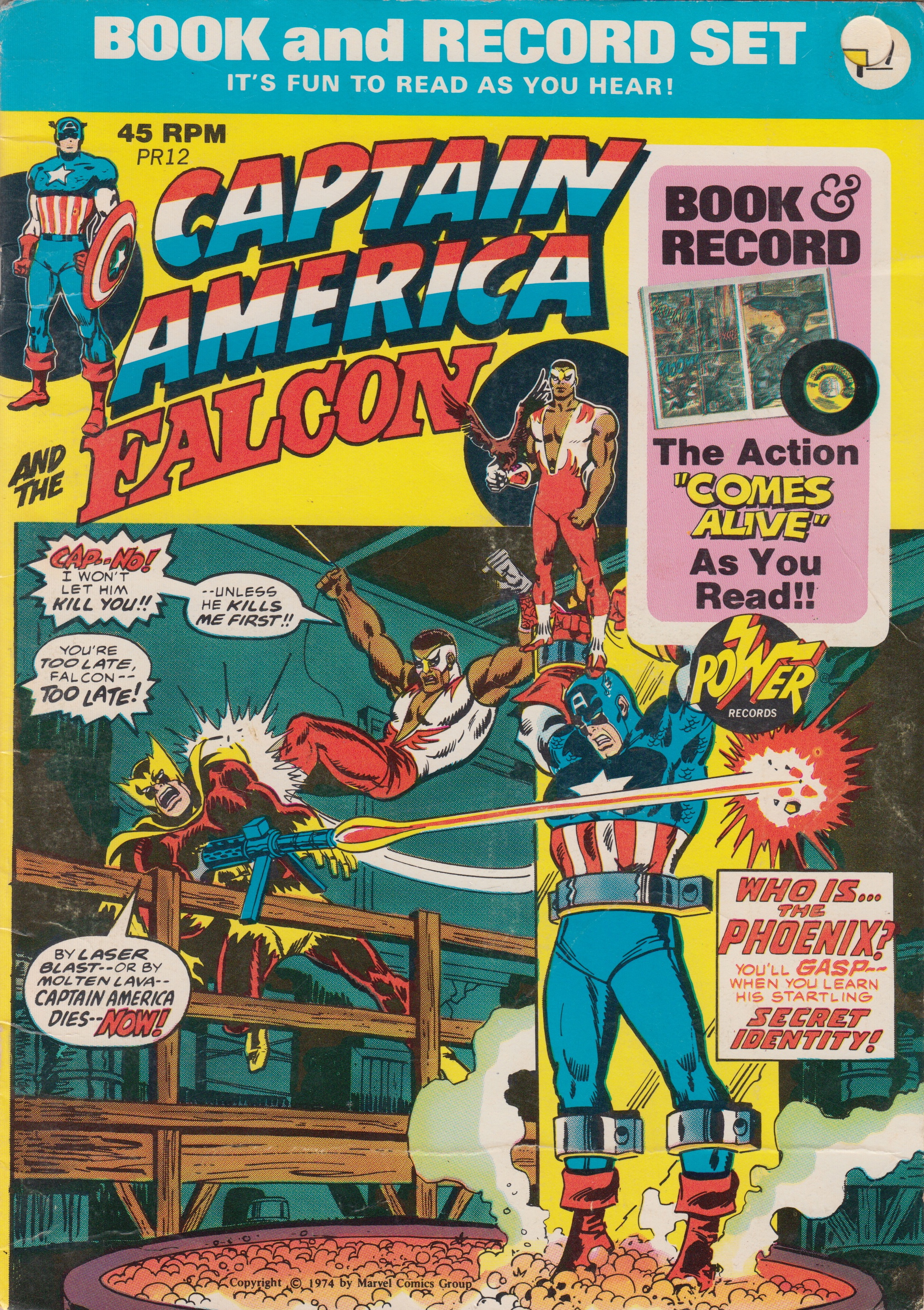
My first exposure to literature—to the “great books” I was asked to study in high school, college, and then in graduate school—came in the form of the book and record sets issued by Power Records in the 1970s.

Scan 4

The cover of Power Records Book and Record Set #12 (dated 1974), adapted from issue #168 of Captain America and the Falcon (Marvel Comics, December 1973), with a cover by Sal Buscema (pencils), John Verpoorten (inks), and John Costanza (letters).

One of my favorites was #14, an adaptation of Mary Shelley’s Frankenstein written by Gary Friedrich and drawn by Mike Ploog for Marvel Comics. Their comic book version of Shelley’s novel originally appeared in the first few issues of The Monster of Frankenstein, edited by Roy Thomas. Issue #1 has a cover date of January 1973. I was born in late November of 1973.

Scan

Issue #1 of The Monster of Frankenstein (Marvel Comics, dated January, 1973). Cover by Mike Ploog.

“It’s fun to read as you hear!” proclaims the copy on the cover of The Monster of Frankenstein, which included a 45 rpm record. At the end of each right-hand page the record would beep, a signal to turn the page to read the next panel. Each set, I realize now, was a radio play. By the late 1970s, radio dramas were already a relic of the 1930s and 1940s, a form of entertainment that had barely survived the 1950s as television took hold as the means of mass communication.

Scan 2

The 45 from my copy of Captain America and the Falcon.

The cover of The Monster of Frankenstein #1 is almost identical to the cover of the Power Records edition of the comic. Both promise a story of “The Most Famous, Most Fearsome Monster of All!” And, as drawn by Mike Ploog, Frankenstein’s creature is a hulking, ferocious presence: his enormous, cinderblock hands reach for his creator. The leather straps that held the creature to the dissection table fail to restrain him. A forlorn skeleton appears in the right-hand corner of the image, waiting for the inevitable struggle between the monster and his creator.

Mike Ploog’s granite-colored antihero is not the John Milton-reading, delicate, misunderstood romantic of Shelley’s text. In a famous sequence from Vol. II, Chapter 6 of Shelley’s novel, the creature stumbles across “a leathern portmanteau” that contains “several articles of dress and some books.” These books include Milton’s Paradise Lost, Plutarch’s Lives, and Goethe’s The Sorrows of Young Werther. In reading these books, Shelley suggests, the monster also learns what it is to be human:

The possession of these treasures gave me extreme delight; I could continually study and exercise my mind upon these histories when my friends were employed in their ordinary occupations. I can hardly describe to you the effect of these books. They produced in me an infinity of new images and ideas that sometimes raised me to ecstasy but more frequently sunk me to the lowest dejection.

When it came time in high school for me to read Frankenstein, I knew what I’d be studying. Friedrich and Ploog’s adaptation, despite the superheroic imagery and action familiar to readers of other Marvel Comics from the 1970s, is generally faithful to the novel.

I think this first exposure to literature in comics form shaped my expectations of the other classic novels assigned in middle school and in high school. I resisted The Catcher in the Rye and The Great Gatsby. My father insisted I would enjoy Salinger’s novel if I gave it a chance, but when I asked him to describe it to me, he could not remember the plot.

Most of the novels my middle school teachers recommended were about dogs—White Fang, The Call of the Wild. The Catcher in the Rye, I reasoned, must be about a dog.

Years before I read the novel, I imagined it: a young boy adopts a beautiful, spirited, bright-eyed retriever. They have adventures together. They follow the course of a major American river. They probably hop a train. Or they hitchhike. Later in the novel, the boy and the dog lose each other in a field of corn that sways in bright, clean, Midwestern sunlight. The sky is blue and cloudless as the boy observes his dog walking the field’s perimeter.

I don’t know, I told my dad. I don’t think I want to read about a dog. They always die at the end. Or they get eaten by something.

And, anyway, my family always had cats, not dogs.

The Catcher in the Rye’s oxblood cover was no help. It was blank except for the title and the name of the author. I took this as further proof that Salinger had written a kind of sequel to Old Yeller.

A few years later, I looked forward to reading The Great Gatsby, a novel about a famous escape artist and magician. To conceal his identity, the hero wears a mask and never speaks about his experiences in World War I. The first fifty pages of the novel describe his relationship with Houdini and with Walter Gibson, a pulp writer best known for his work on The Shadow in the 1930s and the 1940s. The Great Gatsby must be some distant relative of Doc Savage, I thought, except Fitzgerald’s hero probably falls in love and, as a consequence, loses his magic powers. He fights off a pack of dogs at the end. There’s always a dog. Also, he wears a gold mask and dresses in purple.

I enjoyed Fitzgerald’s novel, despite my shock that the story had no magic, no Houdini, no characters with the power to cloud men’s minds.

I still cherish my expectations of The Catcher in the Rye and The Great Gatsby. What I imagined each novel would be is still more compelling for me than the stories they tell. Some part of my imagination will always insist that The Catcher in the Rye is about a dog and that The Great Gatsby is about a spectacular, handsome, world-weary aviator and magician, sort of like this:

Scan 5

A June, 1972 paperback reprinting of the 1939 debut of pulp hero The Avenger written by Paul Ernst under the Street & Smith house name Kenneth Robeson. Author Lester Dent wrote the popular adventures of Doc Savage under the same pen name.

A friend asked me if Allison and I enjoyed Baz Luhrmann’s recent big-budget adaptation of Fitzgerald’s novel. Yes, I said, but I couldn’t bring myself to admit my disappointment that Luhrmann neglected to include the scene in which Gatsby, having failed to win Daisy’s love, dons his cloak of invisibility and vanishes, only to wash up a few days later on the shore of a volcanic island where he and his agents continue their war against various international crime syndicates.

Dartmouth College and the Secret History of Comics Studies

Here’s the line of logic, for those who think it’s been a long journey: if comics are so worthy, howzacum Joe Tobul’s mother tossed out the books I loaned Joe back in 1946 when we were both twelve years old in Painesville, Ohio?

Because Joe’s mother, who was a nice lady, thought they were trash. And why did she think they were trash?

–from Harlan Ellison, “Did Your Mother Throw Yours Out?” (an essay on the growing acceptance of comics as a literary form published as “It Ain’t Toontown” in Playboy, December 1988)

When I arrived in Hanover, New Hampshire for Dartmouth’s Illustration, Comics, and Animation Conference on April 19th, I immediately took Allison and my father to look for the ghost in one of the classrooms in Sanborn House, the school’s English department. The ghost and I crossed paths only once in the fall of 1994, moments before one of my evening creative writing classes. I didn’t see her this time and the classroom she’d once inhabited looked much smaller than it did when I was an undergraduate. But let me talk about the conference as well as Dartmouth’s role in the history of comics studies before I describe the ghost.

8670988529_3519637800

Photo from the 2013 Dartmouth College Illustration, Comics, and Animation Conference courtesy of Allison Felus. You can see more of Allison’s photos of the conference here.

Dartmouth has a small but significant place in the recent history of comics scholarship. Most cartoonists and comics scholars are aware that James Sturm’s Center for Cartoon Studies is only twenty minutes south of Hanover in White River Junction, Vermont. Dartmouth’s Studio Art Department also has a strong animation component, no doubt in part because of the Ivy League school’s popular Film Studies program. Since the late 1980s, however, Dartmouth has played a significant role in the development of comics studies as a vital academic discipline due to the work of scholars including Marianne Hirsch and Michael Chaney.

In an article in The Dartmouth, Chaney, an Associate Professor of English, explained his goals in organizing the sessions. As the conference’s name suggests, the papers and presentations were not exclusively on comics and graphic novels. How do the worlds of animation and book illustration relate to the study of sequential art? What, for example, is the relationship between an illustrated edition of a Laura Ingalls Wilder book and an EC comic?

“The rationale,” Chaney explained in the interview with staff writer Kate Sullivan, “is that all three of these different dimensions are represented: comics, illustration studies, and animation, and so my thought is, if the conference is truly going to be hybrid, in the sense that it would talk in all these disciplines, it would have to risk something.”

Chaney has published widely on issues of hybridity, race, and identity in comics. His collection Graphic Subjects: Critical Essays on Autobiography and Graphic Novels, published by the University of Wisconsin Press in 2011, extends the project Marianne Hirsch began at Dartmouth in the early 1990s as she developed the idea of postmemory in her studies of Art Spiegelman’s Maus. Hirsch, now vice-president of the MLA and a Professor of English and Comparative Literature at Columbia University, spent years as a professor in Dartmouth’s Comparative Literature Department. Hirsch’s work on Art Spiegelman’s Maus has had a tremendous impact on a new generation of comics scholars, most notably Hillary Chute and her study of graphic narratives, memory, and trauma in her recent book Graphic Women: Life Narrative & Contemporary Comics (Columbia UP, 2010).

In her 1997 study Family Frames: Photography, Narrative, and Postmemory, Marianne Hirsch defines postmemory as a form of recollection that “characterizes the experience of those who grow up dominated by narratives that preceded their birth, whose own belated stories are evacuated by the stories of the previous generation shaped by traumatic events that can be neither understood nor recreated” (Hirsch 22). Hirsch’s concept of postmemory, a theory she revisits in her recent book The Generation of Postmemory: Writing and Visual Culture After the Holocaust (Columbia UP, 2012), has inspired numerous scholars in the fields of Holocaust and Memory Studies.

Hirsch’s first book on postmemory, like Michael Chaney’s conference program, crosses genres and disciplines. In Family Frames, Hirsch studies comics, photographs, and her own family history. The book itself is a mixture of historical scholarship, art criticism, and memoir. During my senior year at Dartmouth in 1994, I took a Holocaust Literature course with Hirsch and with historian Leo Spitzer, and I remember a few of my peers resisting the idea that we would be studying a comic book about the Holocaust. In the fall of 1994, Maus had not yet achieved the canonical status it has earned since being awarded a special Pulitzer Prize in 1992. One of the first major academic studies of Spiegelman’s work was Joseph Witek’s pioneering study Comics Books as History (UP of Mississippi, 1989), which included chapters on Maus as well as on the work of Jack Jackson and Harvey Pekar.

In the fall of 1994, I was not aware of Witek’s book. Before Hirsch’s class, my only exposure to comics criticism had been in the pages of fanzines, newspapers such as The Comics Buyer’s Guide, or magazines such as The Comics Journal. Those of us who’d read, for example, Harlan Ellison’s essay on George Carlson, originally published in Dick Lupoff’s fanzine Xero and later collected in the Lupoff and Don Thompson collection All in Color for a Dime (1970) and in Ellison’s 1990 collection The Harlan Ellison Hornbook, believed in comics as a serious art form. I spent most of my first three years of college, however, hiding my interest in comics, as I encountered several professors who were openly dismissive of the form.
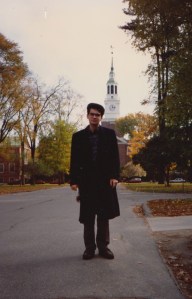
Image 2

A photo of me standing not far from Baker Library sometime in the fall of 1991. Courtesy of my mom.

When I arrived at Dartmouth in the fall of 1991 I hoped to pursue a double-major in English and Studio Art. Since I enjoyed drawing and writing, I thought I might combine the two interests. I’d been reading comic books since grade school and, although by 1991 the “implosion” of so many independent comics companies and the speculator frenzy of the era had dampened my interest in the field, I began my first year with the desire to study words and pictures. I eventually settled on a major in English and Creative Writing, as I found my English and Comparative Literature professors, including Peter Bien, Jonathan Crewe, Melissa Zeiger, Bill Cook, and the late Suzanne Zantop, were open and encouraging when I would admit my affection for comics, zines, and punk rock. I found I struggled with my art professors, many of whom had been trained in schools of modernist painting that privileged the high over the low. Comics, as one of the painting faculty advised me, were mere illustration, not serious art. To return to Dartmouth, then, in 2013, to present a paper on two artists, Edie Fake and Gil Kane, whose work has been so meaningful to me, proved to be more challenging than I’d expected.

I might have been 18 again. I was terrified.

After I learned my paper had been accepted for the conference, I experienced a brief moment of pleasure. Now I’d have the opportunity to return and to articulate my ideas on comics and art with tools and strategies I did not possess when I was 18 or 19. In my first year as an undergraduate, I thought I might convince my art professors of the value of comics by showing them copies of books by Moebius or Hugo Pratt. I was certain they’d like the European artists since, after all, in Ken Viola’s 1987 documentary The Masters of Comics Books Art, which featured interviews with artists ranging from Will Eisner to Jack Kirby, Dave Sim to Art Spiegelman (but, sadly, no segments with Marie Severin, or Trina Robbins, or Richard “Grass” Green), Harlan Ellison explained that, “in Europe, where comic book artists are treated as classical artists,” critics and readers “recognize the importance of this native American art form.”

If Harlan Ellison said it, I thought, it must be true. My professors might not like American comics, but surely they’d love the European ones.

Over the course of my first year of studio art study, I learned that the American and European comic book artists I admired were illustrators, picture-makers. And even though Harlan Ellison had insisted that in Europe comic book artists were understood to be classical artists, I had no luck convincing my professors that Moebius’s Arzach was as profound as Mark Rothko’s No. 8 (Lilac and Orange over Ivory), one of the modern paintings on display in Dartmouth’s Hood Museum of Art.

Image 3

Have you seen the Rothko? a friend asked me.

It must have been our first term at Dartmouth in the fall of 1991.

I don’t think so, I said.

I was afraid to admit that I’d never heard of Rothko. I thought it might be the trade name of some major appliance.

Then we have to see the Rothko at the Hood, she said.

She and I were both comic book fans, and even today, two decades later, we’ll send each other suggestions on comics we think the other one might enjoy. In the fall of 1991, she bought me a copy of Matt Groening’s Life in Hell and I insisted that she read J.M. DeMatteis and Jon J. Muth’s Moonshadow.

Rothko’s painting hung in the Hood Museum on a wall at the top of a flight of stairs. As we walked up the staircase, I saw it coming into view.

It will look like it’s pulsing if you stare at it long enough, my friend assured me.

My head was filled with Jack Kirby, John Buscema, C.C. Beck, Bill Sienkiewicz. As we approached, it revealed itself slowly. It would wait for us. I am sure it had been there years before we’d applied to Dartmouth, and it would remain there years after we’d gone.

Standing before it, I remember thinking, it looks so quiet. Like silence. Like it doesn’t need to be anything other than what it already is.

We stared at it for a few moments and then made our way back to the dining hall in the Hopkins Center.

After graduating from Dartmouth in 1995, I visited only a few times. The Illustration, Comics, and Animation Conference was my first trip through Western Massachusetts and Vermont since the late 1990s. As I read my paper, I found myself pausing again and again to collect my thoughts. I was sitting in a small room in the basement of Haldeman, a bulding which did not exist when I was an undergraduate, but I sensed the anxious, disoriented 17-year old who’d arrived in Hanover in the fall of 1991. Sanborn House, Baker Library, the rehearsal rooms at the Hopkins Center, the ridge of trees behind Rip-Wood-Smith, my dormitory—they all looked so small and so alien.
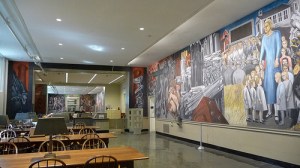
Image 4

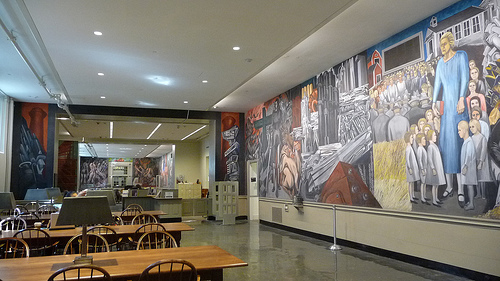
A section of Orozco’s The Epic of American Civilization in the reserve reading corridor of Baker Library. Photo courtesy of Allison Felus.

I visited several old friends while in Hanover, and most of the places that held any meaning to me, or triggered those old memories. We walked through the reserve reading corridor in the basement of Baker Library. There I asked Allison to take a photo of one of the sections of José Clemente Orozco’s mural The Epic of American Civilization. I did most of my studying in this section of the corridor. Even now, when I read Thomas Mann, I remember these murals as they loomed over me the first time I studied “Death in Venice” for the late Werner Hoffmeister’s short fiction course in the fall of 1992.

But I’m forgetting about the ghost. In the fall of 1994 another friend and I had just had dinner and we were standing outside Sanborn House. Afraid to be late for my evening class, I looked up to the window on the second floor of the building and noticed a light. I saw a figure standing in a dim silhouette. I didn’t recognize her. She appeared to be wearing a dress with a high-neck collar. Did I know her? I said goodbye to my friend, entered the building, and dashed up the narrow staircase that leads to the second floor of Sanborn and, at that time, to the small rooms that housed the Composition Center.

When I arrived at the classroom, the lights were out and the door was locked. I saw no one in the hallway or on the stairs.

I’d taken only a few minutes to sprint from the sidewalk and up the stairs to the classroom. Where had she gone? Her shadow might have been a trick of the light, I thought, an illusion as the sun descended. The window, after all, faced the west, the Connecticut River in the distance just beyond the dormitories built after World War II. Or maybe she was a ghost.

In telling this story I might be telling our secret, but as I first saw that figure standing in the window of the classroom almost twenty years ago, and as she failed to wait for me that night in the fall of 1994, I don’t think she’ll mind. I spent so much time in Hanover a few weeks ago remembering the ghost, and the Rothko, and the dining hall conversations, and the dim light of sunset, and the take-out menus from Mei-Mei’s, and the record store, that I didn’t think too much about comics. I thought most about what has vanished.
Doctor Strange # 52 (April 1982)

Doctor Strange #52 (April 1982)

“Life-Times” by Roger Stern with pencils by Marshall Rogers and inks by Terry Austin

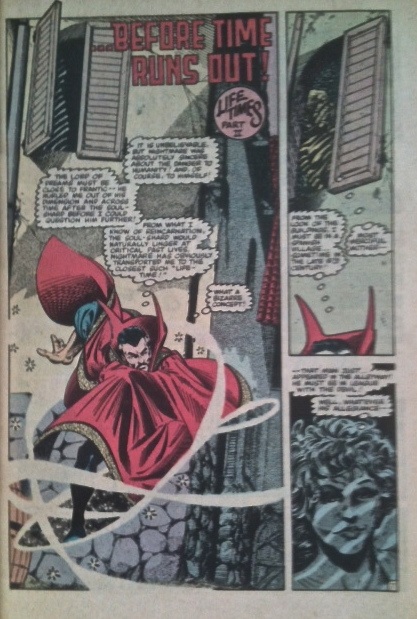
“The Lord of Dreams must be frantic—he hurled me out of his dimension and across time after the soul-shard before I could question him further!”

–Doctor Strange considers the spirit mechanics of dreams, time travel, and reincarnation on page 7 of “Life-Times”

photo (21)

If I am going to write about Doctor Strange I will have to write about magic.  But maybe, as Alan Moore argues in a recent interview, magic has more to do with the mundane world of words and pictures than we might imagine.

In the opening chapter of her 1949 book Ritual Magic, E.M. Butler reminds us that spells cannot exist in the absence of some kind of language (words, pictures, music—any technology human beings have developed in order to express the ineffable).  “The fundamental aim of all magic,” Butler writes, “is to impose the human will on nature, on man or on the supersensual world in order to master them” (Butler 3).  Later, after a discussion of the three branches of magic in the Western tradition—astrology, alchemy, and ritual magic—Butler draws parallels between the practice of magic and the development of the arts:

This is what makes the study of ritual magic still interesting to-day; for the aesthetic element, inherent in the nature of     ceremonial, can be detected struggling to emerge: as craftsmanship in the fashioning of talismans and rings, of instruments and amulets; as draughtsmanship in the inscriptions, diagrams and lettering; as plastic art in the modeling of figures, in the cave-drawings of animals, in portraits of the spirits; as poetry in the prayers and hymns; as drama in the urgency of the invocations, in the manifestations and occasional utterances of the spirits, as well as in the form of the ceremony as such. (Butler 4)

With Butler’s ideas in mind, perhaps we might discover a more complete understanding of the relationship between the art of magic and the art of the comic book, not only in Alan Moore’s work, but also in a popular series like Marvel’s Doctor Strange.

Before I read Doctor Strange #52 (dated April 1982) again, I’d like to pause and include an excerpt from one of the interviews in DeZ Vilenz and Mort Winkler’s 2005 documentary The Mindscape of Alan Moore.  Here Moore describes the gift he gave to himself and to his friends for his 40th birthday: instead of having a midlife crisis, he says, he decided to become a magician.  The pursuit of this new identity posed a number of significant challenges, however, because, as Moore explains,

the problem is that, with magic, being in many respects a science of language, you have to be very careful what you say because if you suddenly declare yourself to be a magician, without any knowledge of what that entails, then one day you are likely to wake up and to discover that that is exactly what you are.

He then offers a definition of magic that echoes Butler’s analysis:

There is some confusion as to what magic actually is.  I think that this can be cleared up if you just look at the very earliest descriptions of magic.  Magic in its earliest form is often referred to as the Art.  I believe that this is completely literal.  I believe that magic is art and that art, whether that be writing, music, sculpture, or any other form, is literally magic.  Art is, like magic, the science of manipulating symbols—words or images—to achieve changes in consciousness.  The very language of magic seems to be talking as much about writing or art as it is about supernatural events.

In most twentieth-century American pulp fiction and comics, magic often is a metonym for the exotic and the Other: it establishes a strict division the white and the black, the male and the female, the serious and the popular, always privileging what society defines as the rational over what it rejects as the irrational.

Is there any magic, then, as Butler and Moore define it, in a comic book like Doctor Strange?  Science fiction and fantasy writer Fritz Leiber would have answered yes.  In Leiber’s fiction, magic and the supernatural provide tools and strategies to understand and engage with forms of consciousness which the rationalism of science might deny or ignore.  In an essay published in the September 1946 issue of Weird Tales, Leiber writes about questions he considered while reading an article on allergies in The Journal of the American Medical Association: “But I found myself wondering, what if the efficient, white-coated physician came up against an emergency that he didn’t know how to meet, that  made even his competent fingers tremble, because it was part of the black, shivery outside?”

After declaring that there remains a “weird realm” which medicine “hasn’t done away with,” Leiber describes a world in which the barriers between science, magic, and the supernatural collapse: “There’s a buried thought that the psychologist can never quite reach, not even when he employs the hypno-analytic technique which can dredge up memories of events that occurred when the patient was six months old.  (And is the buried thought a human thought, or a demon’s?)” (Leiber 1-2).  Leiber explored these ideas, and their relationship to anxiety, depression, and addiction, throughout his career, from early short stories like “Smoke Ghost” to later novels including Our Lady of Darkness.

The early Doctor Strange, stories, of course, manifest these latent fears and anxieties in Steve Ditko’s angular, disembodied images.  Doctor Strange #52, however, features a story written by Roger Stern with artwork by the formidable and influential duo of the late Marshall Rogers on pencils and Terry Austin on inks.  “Life-Times” is a story of reincarnation in which, the first text box of page 1 tells us, “Time has no meaning!” Marshall and Austin have designed a page which illustrates and embodies this opening statement as they reject a more traditional, grid-like structure in favor of a collection of circular, elliptical panels: in the first image in the upper left-hand corner of the page, Doctor Strange and Clea have just “saved Morgana Blessing from the Dread Dormammu amid the rubble of war-torn London.”  Then Stephen Strange and Clea appear at Blessing’s bedside in a hospital in New York City:

photo (23)

Later in the same issue, Doctor Strange arrives in late 15th-century Spain.  In the first panel of page 7, the hero explains the idea of reincarnation to readers: “From what I know of reincarnation, the soul-shard would naturally linger at critical past lives.  Nightmare has obviously transported me to the closest such ‘life-time.’”  Doctor Strange adds, “What a bizarre concept!”

photo (22)

Marshall and Austin’s work is known for its use of repetitive patterns; fitting, then, that they should illustrate a story in which the hero travels through time in order to make sense of Morgana Blessing’s past lives and their affect on her present.  On the issue’s cover, Doctor Strange cradles Morgana’s face in his hands.  She sleeps as a beam of green light streams from his eyes and illuminates her face.  Nightmare’s horse has red eyes and red teeth.  The cover includes four distinct patterns: the Zip-A-Tone shading on hero’s cowl and shoulder; the cross-hatched black lines on Nightmare’s cape and costume; a radiating, web-like net which covers Blessing’s torso; and the free-hand scribbles which decorate the yellow portion of Doctor Strange’s cloak.

In the cover’s right-hand corner is a candle, a Poe-like signifier which tells the reader that this is a comic book about the strange and the supernatural.  As a child I was fascinated by this cover, and it remains intriguing now as I study it.  Those greens and purples, the illusion of weight as Strange’s spotted, orange hands appear from beneath his red and yellow cloak: each of these make the figure of the burning candle superfluous.  This is not a traditional superhero comic book, but something else, something other.  But just because the cover is eerie or strange, of course, does not mean it has anything to do with magic, with that desire to employ language in order to understand and master a world of chaos.

I still wear a replica of the Miraculous Medal my grandmother gave me when I was in grade school.  The story she told was like a Medieval saint’s life: she’d found the medal, she said, snared in the branches of a tree in our backyard.  She saw something shining there in the tree and, when she investigated, discovered the pendant, which features an image of the Virgin Mary and the words, “O Mary, conceived without sin, pray for us who have recourse to thee.”  How did it get in the tree, I wondered?  Some kid must have been playing and throwing it around, she said.  She told me to wear it for good luck and for protection at school.

A few months later, I lost it on the playground, but my mother and grandmother were not concerned.  They prayed to St. Anthony, the patron saint of lost things, and, within a few days, it had been found and returned to me.  I’d been terrified.  What terrible things might happen to me without the medal around my neck?  Losing the medal, however, was less terrifying than finding it.  It seemed more powerful now, more alive, more real, more magical.  When it wanted to be found, it would be found, and when it wanted to disappear, it would disappear.  I’d done nothing to find it. Somehow, it had found me.

Several years later when I was in college the medal disappeared again.  The clasp was delicate.  My father had asked a friend to solder it together, but as I wore the necklace day and night the solder joint decayed, just as the medal itself slowly turned from silver to a dusty black.  I was certain the medal would return.  I only had to be patient and to wait.  When it failed to appear again, my mother bought me a new one, and asked her parish priest to bless it before she mailed it to me in New Hampshire.

Magic seems to be as much about time as it is about language.  That’s what this story, “Life-Times,” would have us believe, anyway.  One moment we are here—sitting at a table in a college dining room, and it is spring, and everyone is young—and then we are here, which is now, at a desk, or on a train, or standing on a sidewalk in cold March sunlight.  Maybe the art of magic is an art of words, or the shaping of words and pictures, but neither one of these expressions can exist without an awareness of time and the distance it creates.

The New Adventures of Superboy #26 (February 1982)

“There’s something about time-traveling I just don’t understand!”

–Superboy, in the story “Superboy Meets Superboy…Almost!” by Bob Rozakis, Jose Delbo, and Joe Giella

photo (2)

(My copy of The New Adventures of Superboy #26DC Comics, February 1982)

My grandmother, Patricia Stango, who died in the fall of 1995 shortly after I graduated from college, would have been 100 years old today, March 1, 2013.  Her parents, Anthony and Monica (Abromaitis) Budris were Lithuanian immigrants who arrived in the United Sates in the early 1900s.  Of her brothers and sisters, my grandmother was the only one born in Lithuania.

Her mother and father, who met in Waterbury, Connecticut, and married when my great-grandmother was only 16, returned to Lithuania one last time to visit their families.  My grandmother was born on that trip, and she liked to tell the story that her mother and father considered throwing her off the boat on their return journey because of the scabs on her head.  They feared they would not be allowed back into the country with a sick baby.  When I was a child I knew my great-grandmother but I was never able to ask her to confirm or deny this story as she spoke no English, at least to me.  This language barrier posed no problem for my grandmother, her brothers and sisters, or for my mother, all of whom speak Lithuanian.

When my sister Alison was born in December 1977, my grandmother and I, already close because of the time we spent together while my mom was teaching high school and my dad was completing his law degree, became roommates.  My grandmother lived with us until her death in 1995, and our house on Bamford Avenue in Oakville, Connecticut, where my mother also grew up, had two small rooms on its second floor.  One was my grandmother’s and the other, newly furnished after my sister’s arrival, was mine.

We shared the same interests, especially as I got older: she listened to Frank Sinatra, The Andrews Sisters, The Ink Spots, and Glenn Miller on WATR or WWCO, Waterbury’s am radio stations, and read romance novels.  She’d spent most of her life working at the factories in Oakville or Waterbury, which, despite the collapse of its factories in the 1970s and 1980s, is still called the Brass City because of its once thriving brass manufacturing industry.  Until 1972, Waterbury was also the home of Eastern Color Printing, which published the first modern comic books in the United States in the 1930s.

By the time I was ten years old I was an avid comic book reader.  While my grandmother read her novels and listened to the swing jazz of her youth, I read my beloved Avengers and Spider-Man comics and listened to The Police or Men at Work on my radio/cassette player.  My interests still mirror hers—words and music.  When I am alone in my office grading papers, I am always listening to music, often a CD collection of Frank Sinatra’s early Columbia singles.  I listen and I am reminded of sitting at my childhood desk and doing my homework.  I listen to the Sintara CD quietly to mimic the sound I heard drifting from the white clock radio on her dresser.

Of all the comics my grandmother bought me, the one I remember the best but enjoyed the least is The New Adventures of Superboy #26, dated February 1982 but published by DC Comics late in 1981.  It might even have been a birthday present.  We found two comics on the spinner rack at the 7-11 on Davis Street in Oakville that day, but I cannot remember which other one I took home.

In the fall of 1981 I was in the second grade.  Earlier that year I’d been placed in what our first-grade teacher called the “second” reading group at my grammar school, St. John the Evangelist School in Watertown, Connecticut.  We were slow readers who spent several hours a week in a classroom in the basement of the school with Sister Mary Louise, a stern, grey-haired woman with black, cat’s-eye glasses and a quilted blue overcoat she wore at recess.  We sat at our desks and struggled to read short, terse sentences in books filled with illustrations of blond boys with crewcuts and girls with blue and white dresses and black, patent-leather shoes.  In every story, and in almost every sentence, there was always a dog, usually a scrappy, long-haired Cocker Spaniel who looked nothing like my great aunt Annie’s dog Spooky.  My mother knew Sister Mary Lousie was a much better reading instructor than our first-grade classroom teacher, so she insisted I stay in the second reading group.

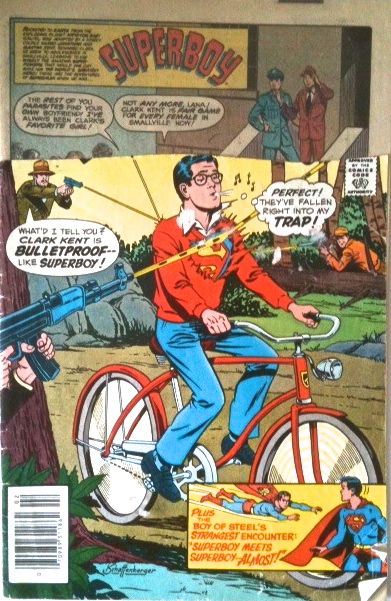
But in the winter of 1981 I spent most of my time staring at the pictures in my comic books.  I think I picked this issue of Superboy because I had no other Superman comics in my toybox.  The violence of Kurt Schaffenberger’s cover might also have appealed to me—Superboy, disguised as Clark Kent, whistles and rides his red bicycle as three machine gun-toting villains ambush him, revealing the Superman insignia concealed under his red sweater.  His eyes closed, Superboy thinks, “Perfect!  They’ve fallen into my trap!

Schaffenberger’s cover, like his artwork for the comic’s first story, “Clark Kent—the Grooviest Guy in Smallville” (a story written by Cary Bates with inks courtesy of Dave Hunt)—is crisp and elegant, more realistically rendered than C.C. Beck’s Captain Marvel stories but with the same economy and clarity.  Like other cartoonists of his generation, Schaffenberger is an artist whose drawings tell the story even if the reader ignores the word balloons and the text boxes.  A perfect comic, then, for an 8-year old still gaining confidence as a reader.

Of the two stories in this issue, however, I prefer “Superboy Meets Superboy…Almost!” written by Bob Rozakis and drawn by Jose Delbo with inks by Joe Giella.  In this time-travel story, one of Superboy’s “Strange Encounters of the First Time,” Clark Kent’s teacher assigns him a research project over his school vacation.  While in the opening panel of the story Clark dreams of skiing “down the lava flow of a volcano,” by the second panel of page 2 he is comparing assignments with Lana Lang.  While she’s been asked to research “the assassination of President James Garfield in 1881!” Clark must, as he explains, “ ‘cover’ a manned space flight in 1962!”  A few panels later, after he decides he’d “rather get a real eyewitness report by traveling back in time—as Superboy,” we see him flying through a time vortex to his destination in the early 1960s.

When he arrives, he discovers the rocket is in danger because one of its engines has failed to fire.  “Looks like I go from watcher to rescuer,” he thinks, but discovers that he is no more than a ghost.  “But why?” he wonders.  “I’ve always been solid before when I time-traveled into the past!”  On the next page he is shocked to see his ten year-old self on a mission to save the rocket.  Yet, as he admits a few pages later, he has no memory of a day in 1962 when he saved an American rocket from the Soviet spies trying to destroy it.

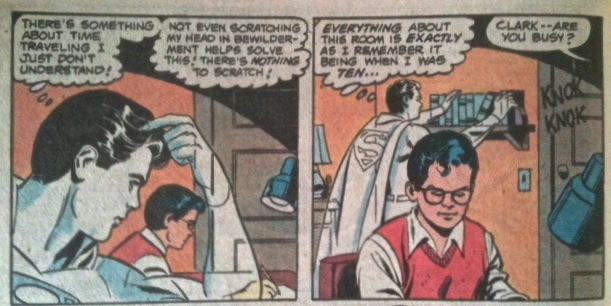
The first two panels on page 7 of the story heighten this mystery of Superboy’s past.  Delbo and Giella draw the now 14 year-old hero as a phantom haunting his bedroom.  “There’s something about time traveling I just don’t understand,” he thinks.  The artists frame the young, disembodied hero in the light cast by the lamp on Clark Kent’s desk:

photo (4)

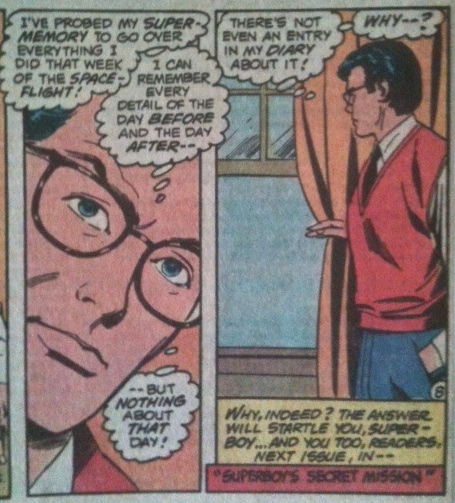
In the first panel, Superboy, a white and blue ghost, tries to scratch his head before he realizes, “There’s nothing there to scratch!” His posture echoes that of his alter ego, who sits studying at his desk.  In the next panel, Superboy studies the books on his shelf: “Everything about this room is exactly as I remember it being when I was ten…”  In the cliff-hanging final panel of the story, the 14 year-old Clark, now back in 1966, admits, “I’ve probed my super-memory to go over everything I did that week of the space-flight!  I can remember every detail of the day before and the day after—but nothing about that day!”

photo (6)

I was hesitant to write about this comic because I remember being disappointed by it after returning home from the 7-11.  The 8-year old me defined a good comic as one like The Avengers, filled with a large cast of colorful heroes.  This issue of The New Adventures of Superboy only has one character who spends most of his time at school or on his bike.  Even though I wasn’t a superhero, I had a bike and I had homework, too.  I wanted a comic book which would transport me to places I didn’t recognize.

I had no idea when I began writing this entry that the second of these two Superboy stories, however, would be about the process of memory.  I selected this issue because, of all the comics which my grandmother bought me when I was a child, this is one of only two, along with an issue of Strange Tales which I wrote about recently at The Comics Grid, which evokes a specific memory of the two of us together.  That “Superboy Meets Superboy…Almost!” is about memory itself is a telling coincidence, perhaps, or one of Walter Benjamin’s secret, magical affinities.

This book, this quiet companion, has been waiting patiently to reveal its secrets, and perhaps it has taken me thirty years to learn how to read it.

I have saved this comic for three decades not for its stories or for its art, but because when I see the cover again I remember Oakville, Connecticut in November or December of 1981, as my grandmother and I walk past the brook which runs parallel with Pullen Ave.  It is cold and damp, but she is holding my hand, and I am not at school, and I am careful to walk close to her as we cross Bamford Avenue to the driveway of our house.  And like Superboy I am a ghost in that world as I watch the two of us walking home.  Meanwhile, here in the present, in Chicago, I stare at a yellowed, fading book which like the hero’s time vortex returns me to my childhood.

Unlike Superboy, who cannot remember the day he saved the rocket, I can recall this quiet walk home, even without the alien gift of supermemory, and so for a few moments I inhabit that space, and see her again in the same perfect clarity as the four-color images in this comic book.

Happy birthday, Grammy.

Scan0121